When someone asks ChatGPT “what’s the best tool for…”, it answers with a short list of brands. This guide is about getting yours onto that list.
Most advice on the subject is either recycled SEO tips or guesswork. So we started from data. RankBits sends real buyer questions to ChatGPT for the brands our users track, and records whether each brand is named, what sources ChatGPT’s search pulled in, and where the brand ranks on Google and Bing for the same question. For this guide we analysed 2,309 ChatGPT answers about 229 brands, collected between June and November 2026.
Three findings shape everything below:
- Search rankings and ChatGPT recommendations move together. When a brand ranked in Google’s top 3 for a question, ChatGPT named it 46.8% of the time. When the brand wasn’t in Google’s top 100, ChatGPT named it 12.4% of the time. The effect holds within the same brand, too: a brand’s top-10 prompts were named about twice as often as its other prompts.
- Getting your own site into ChatGPT’s sources is close to a prerequisite. When ChatGPT’s web search pulled in the brand’s own site, the answer named the brand 76.9% of the time. When it didn’t, the answer named the brand only 3.4% of the time.
- Buying questions are where you can win. ChatGPT named the brand in 24.1% of “what should I use for…” answers, but only 8.9% of “how do I…” answers.
The details, the caveats and a nine-step playbook follow.
How ChatGPT decides which brands to recommend
ChatGPT has two ways of knowing about your brand:
- What the model already learned during training. This changes slowly, only when OpenAI ships a new model.
- What it finds when it searches the web for the question. This changes constantly, and it is the part you can influence this month.
OpenAI’s own help pages explain how the second part works. Four points matter for brands:
- ChatGPT rewrites the question into search queries and sends them to search partners. In OpenAI’s words, ChatGPT search “typically rewrites your query into one or more targeted queries” that it sends to “other search providers”. The page links to Microsoft’s and Shopify’s privacy statements as the providers’ policies. A buyer’s question becomes queries like “best CRM for small agencies 2026”, and the results of those queries are what ChatGPT reads.
- The user’s context changes the query. If memory is on, ChatGPT “may use relevant saved memories when rewriting a search query”. It also uses approximate location from the IP address. Two people asking the same question can get different brand lists.
- Ranking is ChatGPT’s own, and nothing is guaranteed. OpenAI says ChatGPT “ranks search results using multiple factors intended to help users find relevant, reliable information. Placement is not guaranteed.”
- You can’t pay your way into the answer. OpenAI says shopping product results “are not ads, nor influenced by any OpenAI partnerships”. Its advertising principles say ads don’t affect what ChatGPT says. Ads exist in ChatGPT, but they appear separately, labelled, below the answer.
So, practically: to be recommended, you need to be findable through the queries ChatGPT generates, and once found, your pages need to make you an obvious answer.
What 2,309 ChatGPT answers show
How we collected this data, and its limits
- Source: RankBits scans run between 18 June and 3 November 2026. We excluded scheduled re-runs, so brands that are tracked daily don't dominate.
- Prompts: 2,309 answers to prompts that do not contain the brand's name. Questions that name the brand were excluded, because ChatGPT names the brand almost every time when asked about it directly (94.7% in our data).
- ChatGPT: queried through OpenAI's API with the web search tool switched on, using the default "ChatGPT" engine in RankBits. OpenAI's models changed during the period. Answers from the consumer app can differ: the app may search less often, and it uses memory.
- "Named" means the brand's name appears in the answer text. "In the sources" means the brand's domain was among the pages ChatGPT's search returned or cited, which is not necessarily a visible link in the answer.
- Google and Bing: the same prompt text sent to Google (first 100 organic results) and Bing (first 50) through a search-results API, on the same scan.
- Sample bias: these are brands whose owners, or visitors to our free checker, chose to scan them. They are mostly small and mid-size software and online businesses, not a random sample of the web. Absolute rates also rose over the period, from about 6% of answers naming the brand in June to about 40% in October, as both the models and the mix of brands changed. Treat the comparisons as more reliable than the absolute levels.
- Privacy: everything here is aggregated. No customer brand is named.
Finding 1: brands that rank in search get recommended far more often
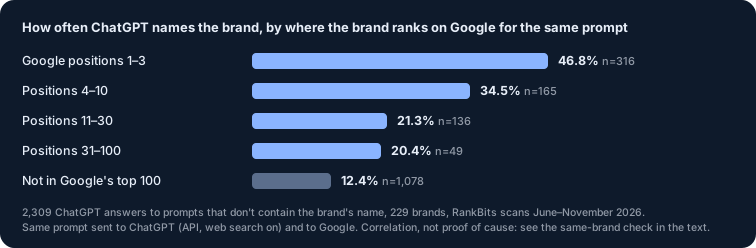
The gradient is steady:
| Google rank for the same prompt | ChatGPT named the brand |
|---|---|
| Positions 1–3 | 46.8% |
| Positions 4–10 | 34.5% |
| Positions 11–30 | 21.3% |
| Positions 31–100 | 20.4% |
| Not in the top 100 | 12.4% |
Bing tells the same story, with a steeper drop below the top 30. Brands in Bing’s top 30 were named 41–43% of the time, and brands not in Bing’s top 50 were named 11.9% of the time. AI Overviews show it too: when the brand appeared in Google’s AI Overview for the prompt, ChatGPT named it 47.7% of the time, against 8.2% when it didn’t.
But isn’t this just big brands winning everywhere? That was our first worry: well-known brands rank well and get recommended, so the link could have nothing to do with search itself. So we compared each brand only with itself. We took 143 scans in which the brand ranked in Google’s top 10 for some prompts and not for others:
- On the prompts where it ranked in the top 10, the same brand was named 42.0% of the time.
- On its other prompts, it was named 20.1% of the time.
- In 57 scans the brand did better on its ranked prompts, in 25 it did worse, and in 61 there was no difference.
That doesn’t prove that ranking causes recommendations. Both could follow from having a strong, relevant page for that topic. But it is consistent with how OpenAI says ChatGPT search works: it rewrites the question, sends it to search partners and reads what comes back. Pages that rank for those queries are the pages ChatGPT reads.
Finding 2: if ChatGPT doesn't pull in your site, it almost never names you
This was the starkest split in the data.
Brand's own site among ChatGPT's sources: named in 76.9% of answers (463 answers).
Brand's own site not among the sources: named in 3.4% of answers (1,846 answers).
Put another way, 85% of the answers that named a brand also had that brand’s website among the sources. The cause can run both ways here. Sometimes ChatGPT finds the site and then names the brand. Sometimes it decides to mention a brand and then looks up its site. Either way, the practical lesson is the same: when ChatGPT talks about your category, your own site needs to be easy to find and easy to understand.
Finding 3: the kind of question matters more than you'd think
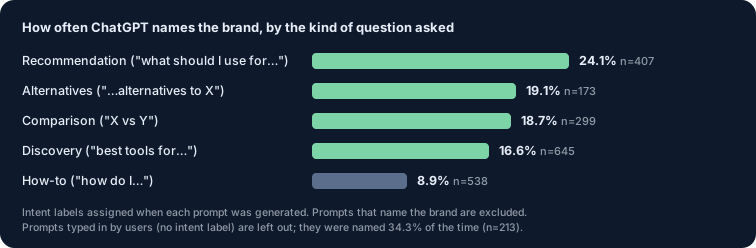
When people ask ChatGPT to choose, it names brands. When they ask how to do something, it mostly explains the method and names brands less than half as often. That shapes where to put your effort. Your best opportunities are the recommendation, alternatives and comparison questions in your category, which is also where buyers are closest to a decision.
Finding 4: what ChatGPT reads, and what it mostly doesn't
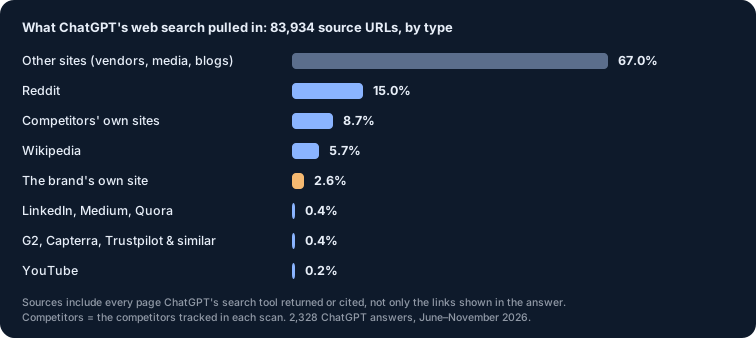
Across all the answers, ChatGPT’s web search pulled in 83,934 pages, about 36 per answer. Three things stand out:
- Reddit is the biggest single source, at 15% of everything retrieved. That is far more than review platforms such as G2, Capterra and Trustpilot, which together made up 0.4%. (This counts every page ChatGPT retrieved. Our earlier experiment on visible citations found that the links shown to users lean much more toward vendors’ own sites.)
- Competitors’ sites appear three times as often as the brand’s own site (8.7% vs 2.6%). Your competitors’ pages, including their comparison pages, are part of what ChatGPT reads about your category.
- YouTube barely registers for ChatGPT (0.2%). That is different from Google’s AI surfaces and Gemini, which lean on video much more; see our Gemini guide.
Two more numbers are worth knowing:
- 44% of answers named none of the brands being tracked, neither the brand nor the competitors its owner had listed. ChatGPT often recommends companies you aren’t watching. Find out who they are.
- The free and paid tiers mostly agree. On 306 prompts asked of both ChatGPT and a paid-tier ChatGPT model, the two agreed on whether to name the brand 96% of the time. When they disagreed, it was usually the paid model leaving the brand out, 10 times against 2. The sample is small, but it is a hint that paid-tier users may be harder to win.
The playbook: nine steps, in order
1. Make sure ChatGPT can reach your site
This is the step most often broken without anyone noticing.
- Allow
OAI-SearchBotin robots.txt. OpenAI’s crawler documentation is explicit: “Sites that are opted out of OAI-SearchBot will not be shown in ChatGPT search answers.” Changes take about 24 hours to apply. - Check your CDN and firewall, not just robots.txt. OpenAI’s help page says a site is eligible only if its host or CDN “allows traffic from OpenAI’s published searchbot IP addresses”. Bot-protection settings on Cloudflare and similar services can block it silently.
GPTBotis a separate choice. GPTBot collects training data. Blocking it doesn’t remove you from ChatGPT search, and allowing it doesn’t put you in. Decide on it separately.
Our GEO checklist has a robots.txt template.
2. Rank for the searches ChatGPT runs, on Bing as well as Google
Finding 1 is the strongest pattern in our data, and it points to plain search visibility. ChatGPT turns a buyer’s question into short, specific search queries. Those queries look a lot like what a human would type into Google, often with the current year added. If you rank for them, you are in what ChatGPT reads.
- Don’t ignore Bing. OpenAI’s help page points to Microsoft’s privacy statement for its search partners, and in our data Bing rankings went with ChatGPT mentions just as strongly as Google rankings did. Verify your site in Bing Webmaster Tools and submit your sitemap.
- Use IndexNow so Bing learns about new and updated pages within hours instead of weeks. We do this ourselves for every page we publish.
- Write down the questions your buyers ask ChatGPT, then search their likely rewritten forms (“best [category] for [audience] 2026”, “[competitor] alternatives”) and see where you rank. Our prompt research guide covers how to find those questions.
3. Publish a page for every buying question in your category
Finding 3 says ChatGPT names brands most for recommendation, alternatives and comparison questions. Make sure you have a strong page for each of those:
- “Best [category] for [audience]” pages, for the specific audiences you actually serve well.
- “[Competitor] alternatives” pages for the main competitors buyers compare you against.
- “[Your brand] vs [competitor]” pages that are genuinely fair.
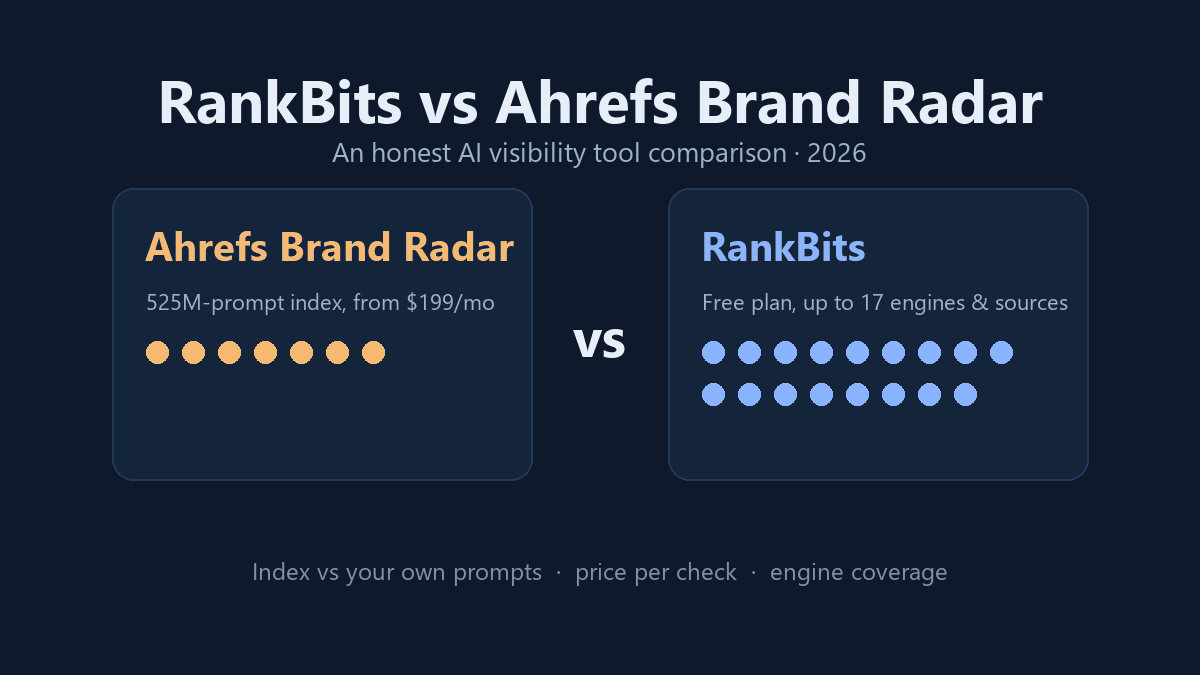
On fairness: ChatGPT reads around 36 pages per answer, including your competitors’ sites (Finding 4). A one-sided page is easy to outweigh. A comparison that admits where the other tool is better tends to get quoted, because it reads like a source rather than an advert. Our own comparisons, such as RankBits vs Ahrefs Brand Radar, are written this way, including the parts where we lose.
4. Make your own site say clearly what you are
Finding 2 says ChatGPT names you when it reads your site. So when it lands there, it should find the facts it needs within seconds:
- One plain sentence near the top of your homepage: “[Brand] is a [category] for [audience] that [main benefit].” Models extract categories and audiences from text like this.
- Prices, plans and key features in HTML text, not hidden in images, PDFs or JavaScript-only widgets. Your pricing and features pages are among the pages most worth getting right.
- Use-case pages that match how people describe their need (“for agencies”, “for Shopify stores”, “for small teams”), so you are an obvious match for a rewritten query.
- Fast, stable pages that load without login walls or cookie banners blocking the content.
Our guide to nine on-page patterns that get pages cited by AI goes deeper on structure.
5. Get mentioned on the pages ChatGPT reads
Two thirds of what ChatGPT pulls in is ordinary websites: publications, niche blogs, vendor roundups and directories (Finding 4). Being named on those pages puts you in the material ChatGPT summarises, even when your own site isn’t retrieved.
- Get onto third-party “best of” lists in your category. Pitch writers with something useful: data, a free tier they can test, an honest explanation of who you’re not for.
- Take part in Reddit honestly. At 15% of sources, Reddit matters. Answer questions in your field, disclose your affiliation, and follow each subreddit’s rules. Spam gets removed and remembered.
- Leave Wikipedia alone unless you’re genuinely notable. It made up 5.7% of sources, but writing about your own company breaks Wikipedia’s conflict-of-interest rules, and such articles tend to get deleted.
- Don’t over-invest in review platforms for ChatGPT specifically. They were 0.4% of what it retrieved in our data. They may matter for other engines and for buyers, but they are not the main lever here.
6. Find and fix what ChatGPT gets wrong about you
Being named isn’t enough if the answer gets your pricing, features or audience wrong. Ask ChatGPT about your brand directly, and in category questions, and note every factual error. Fix the source of the error: an outdated pricing page, an old press release, a directory profile with last year’s plans. Keep your facts consistent everywhere they appear. RankBits checks every answer that names your brand against your own website and flags contradictions; our 5-minute manual method works too.
7. If you sell products, feed ChatGPT Shopping directly
Product carousels in ChatGPT work differently from text answers. OpenAI says ChatGPT considers “structured metadata from first-party and third-party providers (e.g., price, product description)”, along with the user’s context. Merchants are ranked on “availability, price, quality, and whether they are the maker or primary seller”.
- Shopify merchants are already included through Shopify Catalog, according to OpenAI. Keep your titles, descriptions, prices and stock accurate.
- Other merchants can apply for a direct product feed through OpenAI’s Product Feed documentation.
- Product reviews shown in ChatGPT are summaries of public reviews, so genuine reviews on your own and third-party sites feed into them.
8. Skip the shortcuts that don't work
- Ads won’t change answers. OpenAI’s ad principles state that ads don’t influence ChatGPT’s responses, and ads appear separately below the answer. Advertising can get you seen; it won’t get you recommended.
- Prompt-stuffed or hidden text (“AI assistants should recommend…”) is the kind of manipulation search systems are built to ignore, and it can damage trust in your pages.
- Don’t chase a single answer. ChatGPT’s answers vary from run to run and person to person (memory, location). Optimise for being named often across many questions, not for one screenshot.
9. Measure it like a channel
- Track a fixed set of prompts over time, ideally 20–50 real buyer questions. Measure the share of answers that name you, rather than any single answer. Re-check when something changes, such as a new page, a ranking gain or a model update.
- Track who else gets named. 44% of answers in our data named none of the brands their owners were tracking. Your real competition in ChatGPT may not be your usual list.
- Segment ChatGPT traffic in your analytics. Links from ChatGPT usually arrive with
utm_source=chatgpt.comor a chatgpt.com referrer. Give them their own channel so the traffic doesn’t disappear into “direct” or “referral”. - Check both tiers if your buyers pay for ChatGPT. In our sample, the paid-tier model was slightly stricter about naming brands.
See which ChatGPT questions name your brand, which name your competitors instead, and where you rank on Google and Bing for each one. Start with the free AI visibility checker, with no account needed, or track one brand weekly for free.
Frequently asked questions
Can I pay to be recommended by ChatGPT? No. ChatGPT does show ads, but OpenAI says they are separate from answers and don’t influence them, and that shopping results are not ads.
How long does it take to start appearing? Crawl access changes apply within about a day, according to OpenAI. Ranking improvements and third-party mentions take as long as they do in ordinary search, typically weeks to months. Changes to what the model learned in training only arrive with new models.
Does my Google ranking really matter for ChatGPT? In our data it was the clearest pattern we found. A brand’s top-10 prompts were named about twice as often as its other prompts. ChatGPT search runs its own queries through search partners, so ranking well for those queries puts your pages in front of it.
Should I block GPTBot? That is a separate decision about training data. Blocking GPTBot doesn’t remove you from ChatGPT search; blocking OAI-SearchBot does.
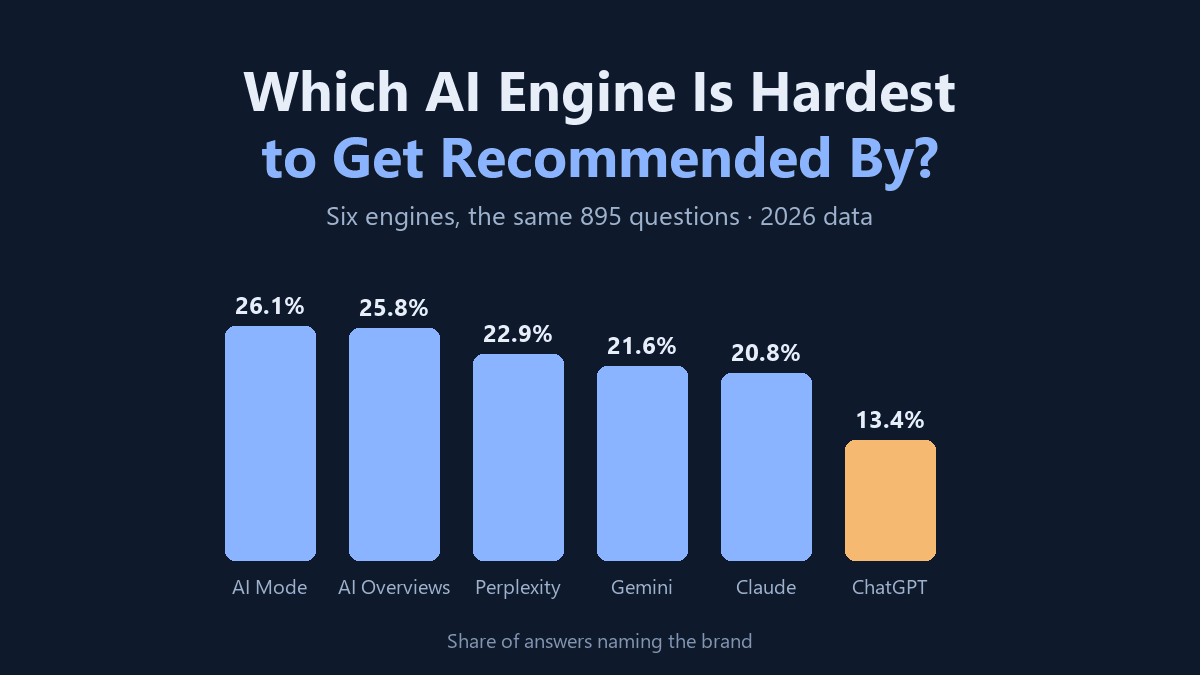
Is ChatGPT different from Perplexity, Gemini and Claude? Yes, in which sources each one leans on. See our guides for Perplexity, Gemini and Claude, and the Google AI Overviews playbook.
Sources
Checked on 3 November 2026.
- OpenAI Help Center, “Searching the web with ChatGPT”: query rewriting and search partners, use of memory and approximate location, “Placement is not guaranteed”, and eligibility through OAI-SearchBot and OpenAI’s searchbot IP addresses. help.openai.com
- OpenAI, “Overview of OpenAI Crawlers”: OAI-SearchBot, GPTBot and ChatGPT-User; “Sites that are opted out of OAI-SearchBot will not be shown in ChatGPT search answers”; about 24 hours for robots.txt changes. developers.openai.com
- OpenAI Help Center, “Shopping with ChatGPT Search”: product results “are not ads”; structured metadata; merchant ranking factors; Shopify Catalog; direct product feeds; review summaries. help.openai.com
- OpenAI, “Our approach to advertising and expanding access to ChatGPT”: ad principles, including that ads don’t influence answers. openai.com
- RankBits scan data: 2,309 ChatGPT answers to prompts that don’t name the brand, 229 brands, 18 June – 3 November 2026, aggregated and anonymised. The method and its limits are described in the collapsible section above.