Something big happened to ChatGPT on May 7, 2026, and most brands haven’t caught up to it yet.
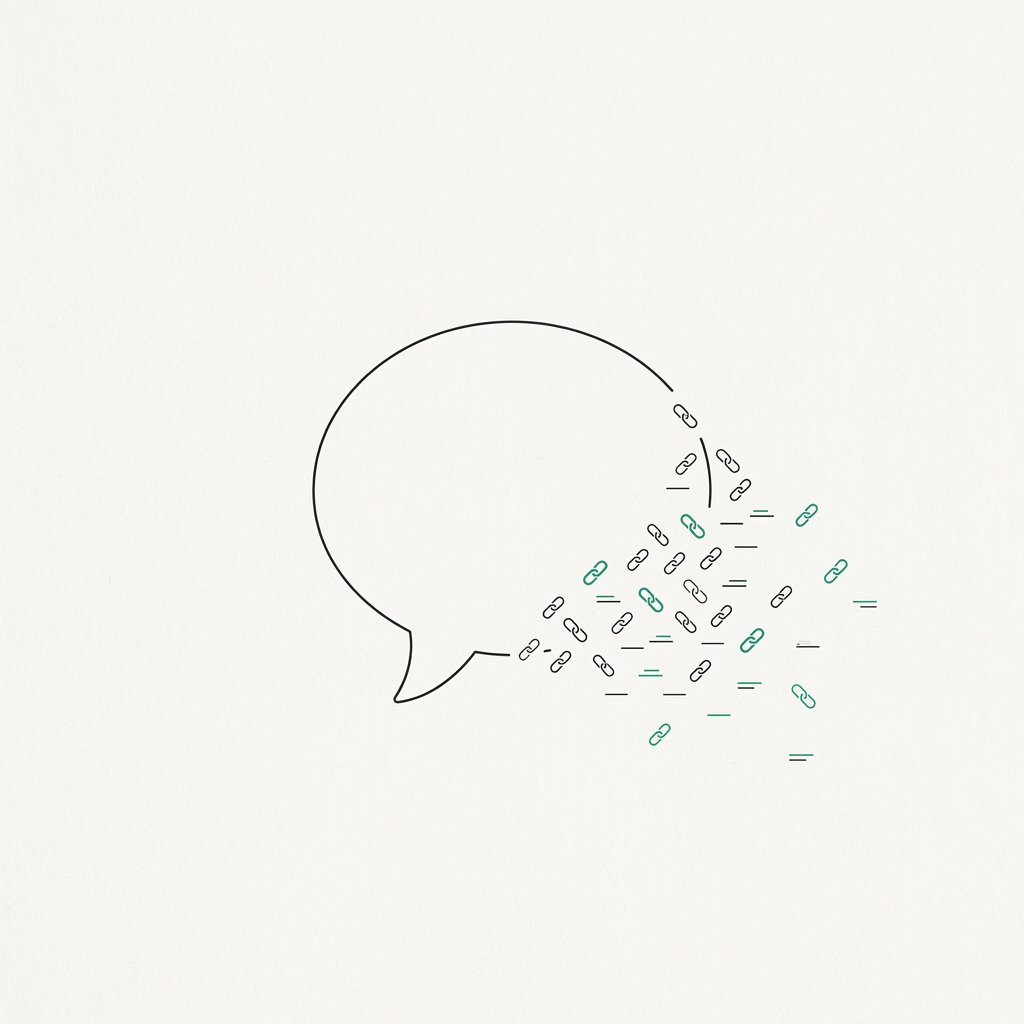
Overnight, OpenAI swapped ChatGPT’s footnote-style citations for clickable brand links embedded directly inside the answer text. Three independent analytics firms — Similarweb, Profound, and Search Engine Roundtable — measured the same event from different angles and landed on the same conclusion: total ChatGPT referral traffic to tracked brands jumped 157.7% week-over-week, and traffic landing on brand homepages specifically jumped 354.7%. Before May 7, roughly 26–32% of ChatGPT referrals landed on a brand’s homepage. After May 7, that number jumped to about 60% — and stayed there.
Being cited by ChatGPT stopped being a vanity metric and became a referral channel overnight. So we decided to stop reading other people’s studies about what ChatGPT cites, and go find out for ourselves — the same way we did a few hours earlier for Gemini.
We ran 20 real, commercial-intent prompts through gpt-5.4-mini — the model that currently powers the free tier of ChatGPT — with its web search tool switched on, and logged every single citation it returned. No cherry-picking. Here’s what we found, and what it means if you’re trying to get your brand into that 60%.
The experiment
Model:
gpt-5.4-minivia the OpenAI Responses API,web_searchtool enabled Prompts: 20 commercial “best [product] 2026” and how-to queries, covering SaaS, ecommerce, security, and productivity categories What we logged: every URL citation returned, every underlying sub-search ChatGPT ran, and whether the search tool fired at all Result: 119 total citations across 49 unique domains
Full disclosure, in the spirit of the honesty we ask of everyone else’s GEO advice: when we asked ChatGPT directly for “best AI visibility tracking tools for brands in 2026,” it did not cite RankBits. It’s a new site. That’s expected — and it’s exactly the gap this article, and our free AI visibility scan, is meant to help close. If you want a faster gut-check than running your own API experiment, our 5-minute manual method for checking whether your brand shows up in ChatGPT is a good place to start.
Finding 1: ChatGPT doesn’t search nearly as often as you’d assume
Two of our 20 prompts came back with zero citations — ChatGPT answered entirely from its training data without touching the web at all. Both were general how-to questions (“how to reduce cart abandonment for an ecommerce store,” “how to track brand mentions in ChatGPT”) rather than “best X 2026” comparisons.
That tracks with Semrush’s independent analysis of 17 months of clickstream data: as of February 2026, ChatGPT enables web search on just 34.5% of all queries — down from 46% in late 2024 — and the rate swings anywhere from 15% to 66.3% depending on the day and the query mix, a pattern Pravin Kumar’s breakdown of the same Semrush data also confirms. Search only fires when the model decides it’s uncertain, when the question involves anything after its training cutoff, or when the user explicitly asks for sources.
Our own sample triggered search on 17 of 19 valid prompts (89.5%) — far above that population average — because “best [product] 2026” is precisely the kind of freshness-sensitive, opinion-seeking phrasing that reliably trips ChatGPT’s search trigger. The takeaway: if your buyers are asking evergreen how-to questions, ChatGPT is probably answering from memory, not from your site. If they’re asking “best X in [current year],” you have a real shot at a live citation — but only if your page exists and is accessible when it looks. For the mechanics of how AI engines fan a single question out into multiple live searches, see our AI Visibility Score breakdown.
Finding 2: it isn’t reviewers who get cited. It’s you.
This is the headline finding, and it’s the opposite of what we found running the same kind of experiment on Gemini just a few hours before this one. There, YouTube alone accounted for 18.7% of all citations. Here, YouTube and Reddit combined accounted for zero.
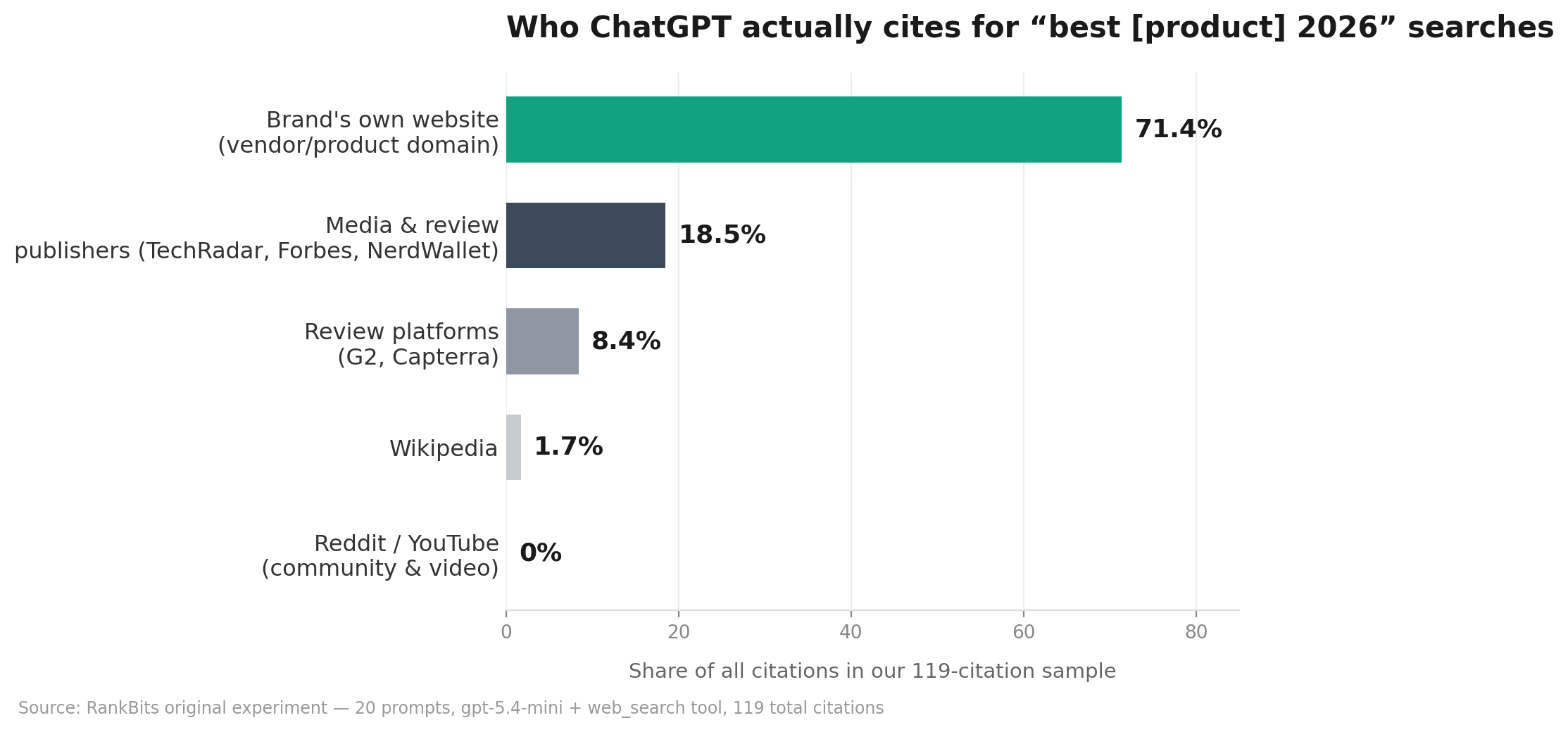
Out of 119 citations across our 20 prompts:
- 71.4% went straight to the vendor’s own website — the product’s homepage, pricing page, or help docs
- 18.5% went to media and review publishers (TechRadar alone accounted for 18 citations — more than any other single domain)
- 8.4% went to review platforms like G2 and Capterra
- 1.7% went to Wikipedia
- 0% went to Reddit or YouTube
That last row deserves a caveat: ZipTie’s 2026 cross-platform citation study found Wikipedia makes up nearly 47.9% of ChatGPT’s top citations overall, and a similar breakdown from Leapd’s comparison of how ChatGPT, AI Overviews, and Perplexity source information shows just how differently each engine weights the same source types. The difference is query type. Wikipedia dominates definitional, “what is X” questions. Owned brand domains dominate “best X 2026” commercial questions — which is precisely the kind of search that decides which vendor a buyer picks. Semrush’s own breakdown of ChatGPT citations by category backs this up: 50% of all ChatGPT citations go to business and service sites (mostly the company’s own domain), with news, blogs, and ecommerce splitting the rest at single digits each.
The practical implication is uncomfortable for anyone who’s been pouring effort into review-site outreach while neglecting their own pricing page: when someone asks ChatGPT to compare tools in your category, the thing most likely to get cited is your own website — if it’s structured well enough to be worth citing. We go deep on exactly what “structured well enough” means in How to Optimize a Page to Get Cited by AI — the on-page patterns there apply directly to the pricing and feature pages this data says matter most.
Finding 3: the fan-out is narrow, but it’s surgical
Gemini, in our earlier experiment, ran an average of 6.78 real-time sub-searches per single user prompt — a wide net. ChatGPT ran far fewer per prompt in our sample, but what it searched for was more targeted: direct brand-vs-brand comparisons and, more importantly, requests aimed squarely at your own domain.
Some of the actual sub-queries we captured:
HubSpot vs Salesforce vs Pipedrive for startups 2026 comparisonQuickBooks vs FreshBooks vs Xero vs Wave for freelancers 2026Grammarly vs Jasper vs Copy.ai 2026 comparison
And in the citations that came back, roughly 55 of the 119 citations pointed not just to a vendor’s homepage but to specific subpages — /pricing, /features, support.* help centers. ChatGPT isn’t just checking whether you exist. It’s checking whether your pricing page loads cleanly, whether your feature comparison is accessible, and whether your help docs answer the specific question the user asked. If that page 404s, redirects awkwardly, or sits behind a JavaScript wall the crawler can’t render, you lose the citation slot to whichever competitor’s pricing page loaded first.
Finding 4: every citation link is a tracking parameter waiting to be measured
Every single one of our 119 citation URLs — 100% of them — carried ?utm_source=openai appended automatically. That’s not a formatting quirk; it’s a gift. If your analytics isn’t segmenting utm_source=openai (and utm_source=chatgpt.com for some surfaces) as its own channel, you are almost certainly under-reporting how much traffic ChatGPT sends you.
Combine this with Semrush’s finding that ChatGPT users click an average of 1.4 external links per visit, compared to just 0.6 for Google users — ChatGPT users are more than twice as click-happy per session once they do search. That traffic is small in absolute volume today, but Similarweb’s Gen AI Stats 2026 report shows ChatGPT’s web visits grew roughly 84% between September 2024 and March 2026. It’s worth tracking properly now, before the volume makes ignoring it expensive.
We’ll come back to exactly how to set this up in GA4 below.
The May 7 earthquake, in full
It’s worth spending a moment on the mechanics of the Branded Link Update, because it changes what “optimizing for ChatGPT” even means.
Before May 7, 2026, a brand mention in a ChatGPT answer usually looked like a plain bold name with a citation footnote at the bottom of the response — easy to ignore, hard to click. Profound’s tracking (across thousands of monitored queries) found that the share of ChatGPT responses containing an inline, clickable brand link jumped from 0.4% to 6.2% on a single day — a 14x increase, a figure also cited in BrandCited.ai’s write-up of the same shift. Their own basket of monitored brand sites saw OpenAI referral traffic roughly double (60–65%) overnight, with homepage share of referrals jumping from about 3.5% to 24% industry-wide.
Similarweb’s independent clickstream panel measured the same event slightly differently but arrived at the same conclusion: total ChatGPT referrals up 157.7% week-over-week, homepage referrals up 354.7%, and — per Search Engine Roundtable’s coverage of the same Similarweb data — a 24% uplift in pageviews per visit and 11% uplift in time on site for that traffic.
Two firms, two methodologies, one unmistakable signal: ChatGPT started actively sending people to brand homepages, at scale, on a specific day, and the volume has held ever since. If your homepage isn’t built to make a strong first impression on someone who just arrived from an AI answer with zero prior context, you’re leaving conversions on the table that didn’t exist a few months ago.
Configuring your crawlers (and a change that catches almost everyone off guard)
OpenAI runs three separate user agents, and conflating them is the single most common technical mistake — the same mistake we flagged in our GEO checklist, except OpenAI’s setup just got more complicated:
| Agent | Purpose | Respects robots.txt? |
|---|---|---|
| GPTBot | Crawls content to train future models | Yes |
| OAI-SearchBot | Crawls and indexes content specifically for ChatGPT’s search/citation feature | Yes |
| ChatGPT-User | Fetches a page live, in real time, because a user’s specific question triggered it | No — as of December 9, 2025 |
That last row is the one that catches people off guard. Per OpenAI’s own crawler documentation — and confirmed independently by Am I Cited’s breakdown of the change and widely flagged on LinkedIn when it happened — OpenAI quietly updated its policy in December 2025 to state that live, user-triggered fetches are no longer bound by robots.txt exclusions; only OAI-SearchBot and GPTBot directives are still honored for opt-outs. In OpenAI’s own words: “ChatGPT-User is not used to determine whether content may appear in Search. Please use OAI-SearchBot in robots.txt for managing Search opt outs.” In practice, that means blocking ChatGPT-User in robots.txt no longer prevents ChatGPT from fetching your page when a user explicitly asks about it in the moment — it only ever controlled automatic crawling, and even that carve-out is now gone. Murat Ulusoy’s technical writeup of GPTBot is a good reference if you’re configuring a WAF around this rather than just robots.txt.
Here’s a robots.txt block that reflects the current, correct behavior:
# Allow indexing for ChatGPT Search citations
User-agent: OAI-SearchBot
Allow: /

# Allow or block training data collection independently
User-agent: GPTBot
Allow: /

# ChatGPT-User (live, user-triggered fetches) is not fully
# controllable via robots.txt as of Dec 2025 — manage sensitive
# content with authentication or noindex instead.
Changes to OAI-SearchBot directives can take up to ~24 hours to be reflected in ChatGPT’s citation behavior, per OpenAI’s own documentation — so don’t panic if a robots.txt fix doesn’t show results the same day.
See which of the 13 AI engines can actually reach your site — and which are blocked without you realizing it. Run a free scan →
The layer other GEO guides skip: ChatGPT Shopping
This is unique to ChatGPT among the major engines, and if you sell anything online, it’s worth knowing about even if you’re years away from using it.
ChatGPT’s Instant Checkout, built on the open Agentic Commerce Protocol, lets ChatGPT surface products and complete a purchase without leaving the chat. It runs entirely on structured product feeds, not on-page content — you push a compressed JSON Lines or CSV file to an OpenAI endpoint (accepted as often as every 15 minutes), and every product needs enable_search=true before it’s even eligible for enable_checkout=true. Per the Agentic Commerce Protocol retailer guide, required fields include title (under 150 characters), description, price with an ISO currency code, availability, and — critically — GTIN, UPC, or MPN identifiers plus publicly accessible, stable-URL return, privacy, and terms pages. Lengow’s merchant control overview notes that Shopify merchants can enable OpenAI’s sales channel natively from their admin panel with no code, while Opascope’s 2026 agentic commerce guide is a useful primer if you’re integrating from a custom platform instead.
The strategic point buried in this: ecommerce brands optimizing purely for editorial GEO content are optimizing for the wrong layer of ChatGPT. Product discovery here runs on feed data quality, not blog posts.
What actually predicts getting cited (and one thing that doesn’t)
Semrush’s April 2026 analysis, built on the same 17-month clickstream dataset referenced earlier, found that sites with more than 32,000 referring domains are 3.5x more likely to be cited by ChatGPT than sites with fewer than 200. Domain authority — built the old-fashioned way, through years of backlinks — remains the single strongest predictor of citation probability. It also found that the top 10 most-cited domains have consistently captured 20–32% of all ChatGPT referral traffic since October 2024. Citation share is concentrated, and it isn’t moving much.
The same analysis, as summarized in Pravin Kumar’s Webflow-focused breakdown, delivered a genuinely useful myth-bust: llms.txt does not measurably affect citation probability. It’s low-cost to implement and may matter more as the standard matures, but if you’re choosing between an afternoon spent on an llms.txt file and an afternoon spent earning one real backlink from an authoritative site in your space, the data says the backlink wins by a wide margin.
The playbook: do this, skip that
Do this:
- Make sure your /pricing and /features pages are crawlable, fast, and don’t require JavaScript to render the actual numbers — this is where a third of our sample’s citations landed. Our on-page patterns for getting cited by AI walks through exactly how to structure that content.
- Set OAI-SearchBot: Allow in robots.txt if you want to appear in ChatGPT citations at all
- Tag and segment utm_source=openai as its own channel in GA4 today, not after volume grows
- If you sell physical or digital products, evaluate the OpenAI Product Feed spec now, even if Instant Checkout isn’t a near-term priority
- Invest in genuine backlinks and domain authority — it’s still the strongest lever, and it’s not going away
- Re-run your own citation checks periodically — our full GEO checklist covers the rest of the fundamentals this article doesn’t repeat
Skip that:
- Don’t port a Reddit-heavy content strategy from Perplexity or Gemini playbooks over to ChatGPT — our data and the wider research agree this isn’t where ChatGPT looks for “best X” answers
- Don’t treat llms.txt as a citation lever — treat it as a nice-to-have, not a priority
- Don’t assume blocking ChatGPT-User in robots.txt hides your content from live, user-triggered fetches — as of December 2025, it largely doesn’t
- Don’t assume every query type behaves like a commercial “best X” query — a Wikipedia-style informational page will see completely different citation logic, and Google’s own AI surfaces add another layer of nuance we cover in AI Mode vs AI Overviews
Monitor and measure
Set up a GA4 channel grouping rule matching utm_source=openai and hostnames containing chatgpt.com, alongside the other AI referrers, so ChatGPT traffic doesn’t get lumped into “Direct” or “Referral” and quietly disappear from your reporting. Seer Interactive’s benchmark study puts ChatGPT-driven traffic at a 15.9% conversion rate, roughly 4.4x the 1.76% baseline for standard Google organic traffic on the same queries — this is traffic worth the two minutes it takes to tag correctly.
Then check back periodically, not just once. ChatGPT’s citation behavior isn’t static — the May 7 update proved that a single product change can shift homepage referral share by 10x almost overnight. Treat “getting cited by ChatGPT” as a channel you monitor on a schedule, the same way you’d track your AI Visibility Score or any other traffic source that can move without warning. If you want the bigger picture on why this all matters, our zero-click search statistics roundup covers what’s happening to traditional organic clicks while AI answers absorb more of the search journey.
Run a free scan to see exactly how ChatGPT (and 12 other AI engines) currently describe your brand. Check your AI visibility →
Sources
- Similarweb — “ChatGPT Referral Traffic Near Triples Overnight” (May 2026)
- Similarweb — “Gen AI Stats 2026: AI Visibility Trends, Data & Insights”
- Profound (tryprofound.com) — “Is Zero Click marketing dead? The branded link update”
- BrandCited.ai — “ChatGPT inline brand links: what the May 2026 shift means”
- Search Engine Roundtable — “Similarweb: ChatGPT Shows More Links Leading To 150% Increase In Referrals” (May 27, 2026)
- Semrush — “ChatGPT traffic analysis: Insights from 17 months of clickstream data”
- Semrush — “26 AI SEO Statistics for 2026 + Insights They Reveal”
- Pravin Kumar — “ChatGPT Search Is Only Active on 34% of Queries” (Apr 2026)
- OpenAI Developer Docs — “Overview of OpenAI Crawlers”
- Am I Cited — “GPTBot vs OAI-SearchBot: Understanding OpenAI’s Different Crawlers”
- Murat Ulusoy — “GPTBot: OpenAI’s Crawler - robots.txt & WAF”
- LinkedIn (Rory Mack) — “OpenAI Exempts ChatGPT from Robots.txt Rules” (Dec 2025)
- ZipTie.dev — “How Different AI Platforms Cite the Same Source Differently” (Mar 2026)
- Leapd — “How ChatGPT, Google AI Overviews, and Perplexity Source Information in 2026”
- Ekamoira — “ChatGPT Instant Checkout: ACP Protocol Retailer Guide (2026)”
- Lengow — “ChatGPT Product Feed and Merchant Control (2026)”
- Opascope — “AI Shopping Assistant Guide 2026: Agentic Commerce Protocols”
- Seer Interactive — Case study: how traffic from ChatGPT converts
- RankBits original experiment — 20 prompts,
gpt-5.4-mini+web_searchtool, 119 total citations (July 1, 2026)