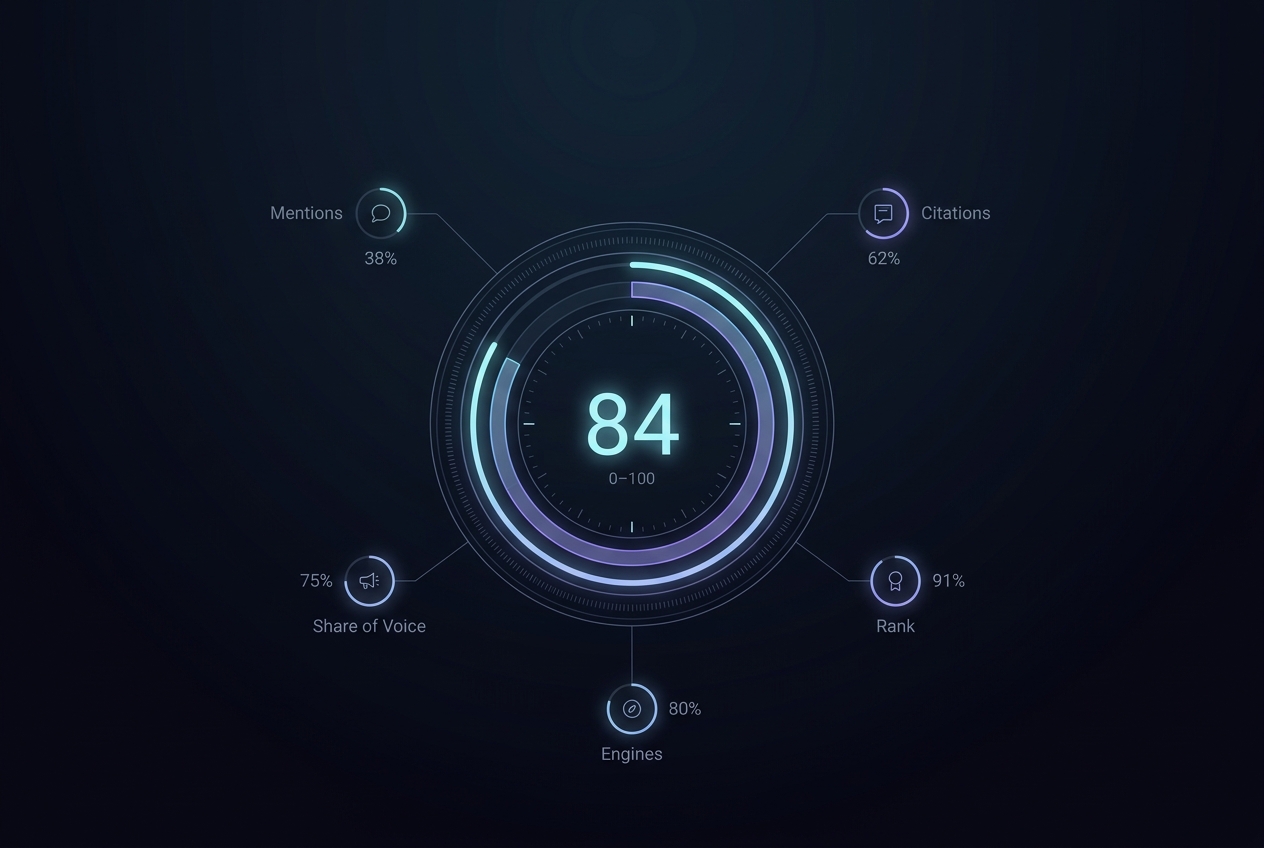
AI Visibility Score is a 0–100 metric for measuring whether AI engines actually find, mention, cite, and recommend your brand when buyers ask category-relevant questions. It is not the same as SEO visibility. SEO asks, “Where does my page rank?” AI visibility asks, “Did the answer engine include us in the answer at all?”
That distinction matters because discovery is moving into answer interfaces. SparkToro and Similarweb found that 68.01% of US Google searches ended without a click in the first four months of 2026, up from 60.45% in 2024. Search Engine Land’s coverage of Seer Interactive’s 2026 AI Overview CTR update also shows why citations matter: when an AI Overview appears, cited pages get materially more clicks than uncited pages on the same results page.
But clicks are only one part of the story. AI engines can mention your brand without linking to you, link to your website without naming your brand, recommend a competitor above you, or describe your product incorrectly. A useful AI Visibility Score has to measure all of those states.
This guide gives you a practical scoring framework, the formulas behind the core metrics, and a real example from a public RankBits scan for CodingFleet.
Want your own score first? Run your domain through RankBits to see mentions, citations, source attribution, competitors, and prompt-level visibility across ChatGPT, Claude, Gemini, Perplexity, Google AI, and the source engines behind them.
The Short Definition
AI Visibility Score is a composite score that measures how visible a brand is inside AI-generated answers across a defined set of prompts, engines, and competitors.
A serious score should combine at least five signals:
- Mention rate — how often the brand is named.
- Citation rate — how often the brand’s domain is linked or used as a source.
- Share of voice — how often the brand appears relative to competitors.
- Position or rank — whether the brand is first, buried, or absent.
- Cross-engine coverage — whether visibility exists across multiple engines or only one.
There is no single universal industry standard yet. AuthorityTech’s definition, for example, uses a weighted composite of entity resolution, mention rate, citation rate, source authority, and cross-engine consistency. Digital Applied’s AI Share of Voice framework separates mention-based, citation-based, and position-weighted share of voice because the same dataset can produce different answers depending on the formula.
That is the key rule: an AI Visibility Score is only meaningful when you know the prompt set, engine set, formula, and date of measurement.
Why AI Visibility Score Exists
Traditional SEO dashboards were built around a simple model:
| Old search measurement | What it tells you |
|---|---|
| Keyword rank | Where your URL appears in search results |
| Impressions | How often your result was shown |
| CTR | How often users clicked |
| Organic sessions | How much traffic search sent |
| Conversions | What that traffic did |
AI search breaks this model. ChatGPT, Gemini, Claude, Perplexity, and Google AI Mode do not present ten equal blue links. They synthesize answers. Sometimes they cite sources. Sometimes they do not. Sometimes they mention a brand without a link. Sometimes they use a source but hide it from visible attribution.
Superlines’ 2026 AI search statistics make the measurement problem clear: their analysis reported large differences in citation behavior by platform — Grok at 27.01% citation rate, Perplexity at 13.05%, Google AI Mode at 9.09%, ChatGPT at 0.59%, and Claude at 0% in that dataset. The same report also describes “ghost citations,” where an engine links to a site but does not name the brand.
Ahrefs’ 75,000-brand research adds another layer: AI visibility correlates more strongly with brand mentions across the web than with classic backlink volume. In its AI Overview study, branded web mentions had a 0.664 correlation with AI Overview visibility, while number of backlinks had a weaker 0.218 correlation. In a later cross-platform study, Ahrefs found YouTube mentions had the strongest correlation with visibility across ChatGPT, AI Mode, and AI Overviews, around 0.737.
The practical takeaway: you cannot infer AI visibility from SEO rank alone. You need to measure whether the answer itself names, cites, ranks, and frames your brand.
The Core Metrics Behind AI Visibility Score
1. Mention Rate
Mention rate measures how often an AI answer names your brand.
Formula:
Mention Rate = (Answers that mention your brand / Total answers tested) × 100
Example: if you run 100 prompts across five engines and your brand appears in 28 answers, your mention rate is 28%.
Mention rate is the most basic signal. It answers: “Are we part of the conversation?”
But mention rate alone is not enough. A brand can be named in a weak, negative, inaccurate, or low-position context. It can also be cited without being named.
2. Citation Rate
Citation rate measures how often the AI answer links to your domain or uses your site as a visible source.
Formula:
Citation Rate = (Answers that cite your domain / Total answers tested) × 100
You can also calculate a stricter version:
Mention-Supported Citation Rate = (Answers that both mention your brand and cite your domain / Answers that mention your brand) × 100
The difference matters. Search layers like Google Search and Bing can cite your pages without “mentioning” the brand in an assistant-style answer. Gemini and Perplexity can also surface what Superlines calls ghost citations — source links without brand naming.
Citation rate answers: “Is our website being used as evidence?”
3. Share of Voice
AI Share of Voice measures your presence relative to competitors in the same prompt set.
There are two common versions:
Mention Share of Voice = (Your brand mentions / All brand mentions in the prompt set) × 100
Citation Share of Voice = (Your domain citations / All domain citations in the prompt set) × 100
Digital Applied’s framework makes an important point: mention-based SoV and citation-based SoV can disagree. A brand may be talked about often but rarely linked. Another may be cited as a source but not named in the prose.
Share of voice answers: “Are we winning or losing the category conversation?”
4. Position / Recommendation Rank
Position measures where your brand appears when an AI answer lists multiple options.
A simple scoring method is:
Position Score = 100 if position #1
Position Score = 75 if position #2
Position Score = 55 if position #3
Position Score = 35 if position #4–5
Position Score = 15 if position #6+
Position Score = 0 if absent
This does not need to be universal. What matters is consistency. Being the first recommendation in “best CRM for startups” is not equivalent to being the seventh brand in a long list.
Position answers: “Are we the recommendation, or just an afterthought?”
5. Cross-Engine Coverage
Cross-engine coverage measures how many engines include your brand at least once.
Formula:
Cross-Engine Coverage = (Engines where brand appears / Engines tested) × 100
This matters because AI engines behave differently. A brand can be strong in Perplexity but invisible in ChatGPT. A brand can be cited by Google Search but ignored by Claude. RankBits tracks this explicitly because relying on one engine creates false confidence.
Cross-engine coverage answers: “Is our visibility durable, or dependent on one platform?”
6. Source Attribution and Source Diversity
Source attribution asks which pages and domains AI engines use when they mention or cite your brand.
Useful breakdowns include:
| Source metric | What it reveals |
|---|---|
| Owned pages cited | Which pages on your domain AI engines trust |
| Competitor pages cited | Which rival pages are winning evidence slots |
| Third-party sources | Which reviews, directories, forums, or publications shape the answer |
| Unique cited pages | Whether citations depend on one page or many |
| Source type | Blog, homepage, docs, review site, Reddit, YouTube, directory, news, etc. |
Source attribution answers: “Why did the engine choose this answer?”
A Practical AI Visibility Score Formula
If you want a simple scoring model for your own reporting, use this:
AI Visibility Score =
  (Mention Score × 0.30) +
  (Citation Score × 0.25) +
  (Position Score × 0.20) +
  (Cross-Engine Coverage × 0.15) +
  (Source Diversity Score × 0.10)
| Component | Weight | Why it matters |
|---|---|---|
| Mention Score | 30% | Measures whether AI systems know and name the brand |
| Citation Score | 25% | Measures whether the brand’s site is used as evidence |
| Position Score | 20% | Measures prominence inside recommendation-style answers |
| Cross-Engine Coverage | 15% | Measures durability across multiple AI systems |
| Source Diversity Score | 10% | Measures whether citations are supported by multiple trusted sources |
This is not the only valid formula. AuthorityTech suggests a different 25/20/20/20/15 weighting with entity resolution and source authority as explicit components. That is reasonable for enterprise brand measurement. The formula above is designed to be easier for marketing teams to calculate manually.
The non-negotiable part is transparency: always disclose your formula.
Real Example: CodingFleet’s Public RankBits Scan
RankBits has a public demo scan for CodingFleet, an AI-powered coding platform. The scan was run on June 28, 2026 and tested 15 prompts across 10 selected engines/sources, producing 150 engine × prompt responses.
Here are the top-line metrics from that scan:
| Metric | Value |
|---|---|
| AI Visibility Score | 38 / 100 |
| Mention rate | 32% |
| Citation rate | 52.7% |
| Coverage | 150 engine × prompt responses |
| Share of voice | 10% for codingfleet.com |
| Unique cited pages | 523 |
| Total source links | 914 |
| Owned cited pages | 28 |
| Competitor cited pages | 99 |
The competitive landscape shows CodingFleet ranked #2 in that scan:
| Rank | Brand | Score | Mention rate | Citation rate |
|---|---|---|---|---|
| 1 | CodeConvert | 42 | 35.3% | 41.3% |
| 2 | CodingFleet | 38 | 32% | 52.7% |
| 3 | Python | 28.5 | 40% | 3.3% |
| 4 | GitHub Copilot | 13.2 | 22.7% | 16% |
This is a good example of why AI visibility needs multiple metrics. CodingFleet had a higher citation rate than CodeConvert in this scan, but CodeConvert still had the higher overall score because it had stronger category visibility across the tested prompts. Python had the highest mention rate among the top three, but a low citation rate because many engines named Python as a language rather than citing python.org as a commercial source.
What the score means
A score of 38 does not mean “CodingFleet owns 38% of AI search.” It means that, for this specific prompt set and engine set, CodingFleet had a meaningful but incomplete AI presence.
In plain English:
- AI engines already know and cite CodingFleet for several code-conversion and code-generation prompts.
- The site has strong source-layer visibility: 28 owned pages were cited.
- CodingFleet’s citation rate is stronger than its mention rate, which suggests some ghost-citation behavior — pages are being linked even when the brand is not always named.
- ChatGPT was the weak engine in this run, with RankBits flagging it as an engine weakness.
- The immediate opportunity is not “publish random content.” It is to improve visibility on the exact prompts and engines where competitors win.
RankBits’ recommendation engine summarized that as: improve ChatGPT visibility with structured content, review prompts where CodeConvert wins, and defend pages that already earn citations.
This is why a scan matters before optimization. Without prompt-level data, you would not know whether to work on Perplexity, Claude, ChatGPT, Google AI, third-party mentions, or owned pages. Run your own RankBits scan →
What Is a Good AI Visibility Score?
There is no universal benchmark because the score depends on your category, prompt set, competitors, and engines. A local law firm, ecommerce brand, developer tool, and Fortune 500 bank should not be judged on the same absolute scale.
Use this as a directional rubric inside the same measurement system:
| Score range | Interpretation | What it usually means |
|---|---|---|
| 0–10 | Invisible | AI engines rarely mention or cite you, even on relevant prompts |
| 10–25 | Weak | Some brand recognition, but competitors dominate most answers |
| 25–45 | Emerging | You appear on important prompts, but coverage is inconsistent |
| 45–65 | Competitive | You are present across multiple engines and prompts |
| 65–80 | Strong | You are frequently recommended, cited, and ranked near the top |
| 80+ | Category-leading | You dominate the prompt set and are consistently cited across engines |
The most useful benchmark is not a generic industry average. It is:
Your score vs. direct competitors
Your score by engine
Your score by prompt cluster
Your score over time
A 38/100 score in a competitive category may be a strong starting point. A 38/100 score for a dominant brand may signal a major AI visibility gap.
How to Build a Reliable Prompt Set
The prompt set is the denominator of the score. If the prompt set is bad, the score is meaningless.
A strong prompt panel should include:
| Prompt type | Example | Why it matters |
|---|---|---|
| Category | “best AI coding assistant” | Measures whether you appear in broad discovery |
| Use-case | “tool to convert JavaScript to Python” | Measures problem-solution fit |
| Comparison | “Cursor vs GitHub Copilot alternatives” | Measures competitor displacement |
| Alternative | “best CodeConvert alternatives” | Measures switching-intent visibility |
| Feature-specific | “AI tool that explains Python code” | Measures feature-level association |
| Audience-specific | “AI coding assistant for students” | Measures ICP alignment |
| Branded | “is CodingFleet good for code conversion?” | Measures accuracy and brand understanding |
For a directional audit, 20–50 prompts can reveal obvious gaps. For a more reliable tracking program, Digital Applied recommends larger buyer-intent panels — often 100–200 prompts — because single snapshots are noisy and platform behavior changes.
RankBits automates this by generating relevant prompts from your domain, letting you add custom prompts, and then tracking results at the engine × prompt level.
How Often Should You Measure AI Visibility?
AI answers are more volatile than classic rankings. They change by engine, model version, location, logged-in state, retrieval mode, and freshness of the source index.
A practical cadence:
| Business need | Suggested cadence |
|---|---|
| One-time baseline | Once before a GEO project |
| Active content optimization | Weekly |
| Brand monitoring | Weekly or biweekly |
| Enterprise/category leadership | Weekly with alerts |
| Low-priority side project | Monthly |
Monthly is better than nothing. Weekly is better if AI visibility is tied to pipeline, reputation, or competitive positioning.
RankBits supports scan history and tracking so you can compare score changes after content updates, PR, new comparison pages, crawler fixes, or competitor movement.
Why Mentions and Citations Must Be Tracked Separately
A common mistake is treating mentions and citations as the same thing. They are not.
| State | Example | Meaning |
|---|---|---|
| Mention only | “CodingFleet is a tool for converting code.” | Brand awareness, but no direct source link |
| Citation only | AI links codingfleet.com/code-converter/python but does not name CodingFleet |
Source authority, but weak brand framing |
| Mention + citation | “CodingFleet offers a Python code converter” with a link | Strongest state |
| Neither | Competitors appear instead | Visibility gap |
Superlines’ ghost-citation finding is the best public example of why this matters: their report says Gemini cited superlines.io 182 times in 30 days while mentioning “Superlines” zero times. Whether or not your category behaves the same way, the measurement lesson is universal: citation tracking and brand mention tracking answer different questions.
RankBits reports both because the fix is different:
- If mentions are high but citations are low, improve source-worthy pages and schema.
- If citations are high but mentions are low, improve brand/entity clarity.
- If both are low, you need broader GEO work: crawlability, content, third-party mentions, and competitor displacement.
AI Visibility Score by Engine
A single blended score is useful for executives, but the engine-level breakdown tells the team what to do.
| Engine | What to inspect | Relevant RankBits tracker |
|---|---|---|
| ChatGPT | Brand mentions, third-party consensus, source visibility, answer framing | ChatGPT Rank Tracker |
| ChatGPT Pro | Whether paid-tier answers recommend different brands | ChatGPT Pro Rank Tracker |
| Claude | Depth, source credibility, structured evidence, expert-style content | Claude Rank Tracker |
| Claude Pro | Paid-tier research and premium reasoning behavior | Claude Pro Rank Tracker |
| Gemini | Google ecosystem signals, brand-owned pages, multimodal/source behavior | Gemini Rank Tracker |
| Gemini Pro | Paid-tier Gemini differences | Gemini Pro Rank Tracker |
| Google AI Overview | Whether Google’s AI summary cites or mentions you | Google AI Overview Tracker |
| Google AI Mode | Multi-turn conversational Google visibility | Google AI Mode Tracker |
| Perplexity | Citation-heavy answer visibility and source position | Perplexity Rank Tracker |
| Google/Bing Search | Source-layer baseline for AI retrieval | Google Search Tracker, Bing Search Tracker |
| Tavily / Exa | AI-native search/source-layer visibility | Tavily Tracker, Exa Tracker |
If your blended score drops, the first question should be: which engine moved? A decline in ChatGPT requires a different fix than a decline in Perplexity or Google AI Overviews.
For engine-specific optimization, see RankBits’ guides on getting cited by Perplexity and getting cited by Claude.
How to Improve Your AI Visibility Score
1. Fix crawlability first
If AI retrieval crawlers cannot access your site, your score has a hard ceiling. Start with robots.txt and retrieval bots such as OAI-SearchBot, ChatGPT-User, PerplexityBot, Claude-SearchBot, and Claude-User. The RankBits GEO checklist covers this in detail.
2. Make your entity unambiguous
AI systems need to understand who you are, what category you belong to, and which claims map to your brand. Keep brand descriptions consistent across your homepage, about page, schema, LinkedIn, Crunchbase, review profiles, and major directories.
3. Build answer-first pages
AI engines extract passages. Structure important pages with:
- Direct answers in the first paragraph of each section
- Descriptive H2/H3 headings
- Comparison tables
- Short definitions
- FAQs
- Current dates and sources
- Clear product/category language
4. Earn mentions beyond your own website
Ahrefs’ research is clear that web-wide brand mentions correlate strongly with AI visibility. That includes articles, guides, YouTube descriptions and transcripts, reviews, directories, podcasts, and community discussions.
Do not spam. The goal is not manufactured mentions. The goal is a consistent, verifiable footprint that AI systems can trust.
5. Strengthen pages that already get cited
Your best starting point is not always new content. In the CodingFleet demo, 28 owned pages were already cited. RankBits labels those as “defend” opportunities: keep them fresh, add schema, improve internal links, and expand them into stronger answer assets.
6. Attack prompt-level competitor gaps
If a competitor wins “best X,” “X alternatives,” or “X vs Y” prompts, create content specifically for those prompts. Generic blog posts rarely move AI visibility as much as targeted pages that answer the exact questions engines already retrieve.
7. Re-scan after every major change
Do not assume optimization worked. Re-run the same prompt set and compare:
- Score change
- Mention rate change
- Citation rate change
- Engine-level change
- Competitor movement
- New source pages
- Lost source pages
This closes the loop between GEO work and measurement.
Common Mistakes
Mistake 1: Treating one answer as proof
AI outputs vary. One screenshot from ChatGPT is not a measurement program. Use repeated, consistent prompt testing.
Mistake 2: Tracking only branded prompts
If the prompt includes your brand name, you are testing lookup accuracy — not discovery. Non-branded category and comparison prompts matter more.
Mistake 3: Ignoring source links
A brand mention without a citation is useful for awareness. A citation without a mention is useful for authority. The strongest state is both.
Mistake 4: Averaging engines too early
A blended score can hide engine-specific problems. Always inspect the per-engine view.
Mistake 5: Comparing scores across tools without methodology
Two tools can produce different scores for the same brand because they use different prompts, engines, regions, sampling methods, and weights. Compare trends inside the same system.
Mistake 6: Optimizing for traffic only
AI visibility can influence buyers without producing a click. As RankBits’ zero-click search statistics show, clickless discovery is now a major part of search behavior. Track answer presence, not only sessions.
The Executive Dashboard: What to Report Monthly
A useful monthly AI visibility report should fit on one page:
| KPI | Why it matters |
|---|---|
| AI Visibility Score | Executive-level directional health |
| Mention rate | Brand presence in AI answers |
| Citation rate | Whether your domain is used as a source |
| Share of voice | Competitive category position |
| Top winning prompts | Where you are strongest |
| Top losing prompts | Where competitors displace you |
| Weakest engine | Where to focus optimization |
| Top cited owned pages | Pages to defend and refresh |
| Top competitor sources | Pages/sites shaping rival visibility |
| Score trend | Whether GEO work is compounding |
This turns AI visibility from a vague fear into an operating system: measure, diagnose, improve, re-scan.
Final Takeaway
AI Visibility Score is not a vanity metric if it is built correctly. It is a compact way to answer the questions that traditional SEO dashboards miss:
- Do AI engines know our brand?
- Do they cite our website?
- Do they recommend us before competitors?
- Which prompts do we win or lose?
- Which engines are weak?
- Which pages are trusted sources?
- Is our visibility improving over time?
The brands that measure this now will have a structural advantage. They will know which AI engines already trust them, which competitors are taking the answer slots, and which pages deserve investment.
Run your domain through RankBits to get your AI Visibility Score, prompt-level breakdown, competitor landscape, source attribution, and engine-by-engine recommendations.
Sources
- RankBits public demo scan — CodingFleet AI visibility report
- RankBits — Zero-Click Search Statistics 2026
- RankBits — GEO Checklist: 12 Steps to Get Your Brand Cited by AI Engines
- RankBits — How to Get Your Brand Cited by Perplexity AI
- RankBits — How to Get Your Brand Cited by Claude AI
- SparkToro & Similarweb — “In 2026, Less than One Third of Google Searches Still Send a Click” (June 2026)
- Search Engine Land — “Google AI Overviews CTR shows early signs of recovery: Study” (April 2026)
- Seer Interactive — “AIO Impact on Google CTR: 2026 Update” (2026)
- Ahrefs — “An Analysis of AI Overview Brand Visibility Factors (75K Brands Studied)” (May 2025)
- Ahrefs — “Top Brand Visibility Factors in ChatGPT, AI Mode, and AI Overviews (75k Brands Studied)” (December 2025)
- Digital Applied — “AI Share of Voice: Tracking Brand Citations in AI Answers” (June 2026)
- AuthorityTech — “AI Visibility Score: Definition, Formula, and Why SOV Is Obsolete” (April 2026)
- Superlines — “AI Search Statistics 2026: 60+ Data Points on Visibility, Citations, and Traffic” (2026)
- Conductor — AI Share of Voice Benchmarking
- Google Search Central — AI features and your website