If you're shopping for an AI visibility tool and want broad engine coverage without enterprise pricing, two names stand out: Rankscale — the Vienna-based platform with 17+ engines, a €20 entry point, and an AI Readiness Score that audits 200+ page checkpoints — and RankBits — the bootstrapped tool with 18 engines, a $0 forever free tier, and flat monthly pricing.
These are the two most affordable tools in the category with genuinely broad engine coverage. They're also the two that don't charge per-engine add-on fees. But they make very different trade-offs on pricing model, page audits, and who they're built for.
I'm the founder of RankBits. I've written honest comparisons against Peec AI, Otterly, and Profound — each of which told readers to pick the competitor in specific scenarios. This article follows the same rule: tell you where Rankscale is genuinely better, where RankBits wins, and which tool fits which buyer.
- Side-by-side pricing, engine coverage, and feature comparison with charts
- Radar chart showing strengths across 8 dimensions
- The credit model vs flat pricing — and why it matters more than the sticker price
- Where Rankscale is genuinely stronger — and where it isn't
- Where RankBits wins — and the honest trade-offs
Quick Comparison Table
| RankBits | Rankscale | |
|---|---|---|
| Founded | 2026 (June) | 2024 |
| HQ | Remote | Vienna / Königstetten, Austria |
| Funding | Bootstrapped | Bootstrapped (~$915K est., ~$220K ARR) |
| Employees | Small team | ~2–12 |
| Users | Early stage | 1,000+ active users |
| Notable customers | — | Bosch, UBS, Cartier, O2, Dentsu, Publicis Sapient, WPP |
| OMR Reviews | — | 4.6/5 (26 reviews). Editorially selected by OMR Reviews. |
| Free tier | Yes — $0 forever, 1 brand, 5 prompts, 5 engines, weekly | 7-day free trial. Free AI Readiness Audit (no signup). |
| Entry paid plan | $49/month (Starter) | $20/month (Essentials — 120 credits) |
| Mid-tier | $99/month (Pro — 18 engines, flat) | $99/month (Pro — 1,200 credits) |
| Top self-serve | $99/month (Pro) | $780/month (Enterprise — 12,000 credits) |
| Pricing model | Flat monthly. Fixed prompts × engines × responses. | Credit-based. Each engine query costs a fraction of a credit. Claude costs ~8× more than ChatGPT. |
| Max engines | 18 (Pro plan, all included, flat) | 17+ (all plans, all included, credit-weighted) |
| API access | Included on all plans including Free | Growth ($385/mo) and Enterprise ($780/mo) |
| Page audit | No | Yes — AI Readiness Score: 200+ checkpoints (crawlability, schema, content, authority) |
| Looker Studio connector | No | Yes (Pro+) |
| MCP server | Yes | No |
| White-label | No | Yes (Growth+) |
| Unlimited seats | No (per-account) | Yes — all paid plans |
| Co-founder onboarding | No | Yes — daily 1-hour video calls with the founder, all plans |
Pricing: Flat vs Credit-Based
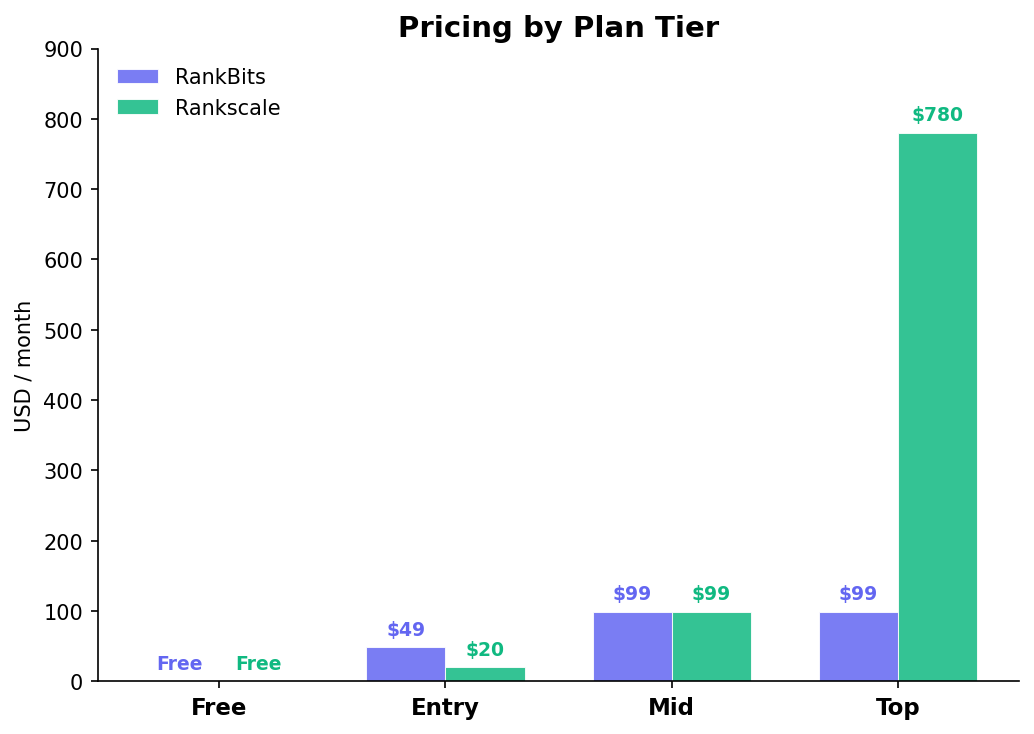
At first glance, Rankscale looks cheaper: $20/month versus RankBits' $49/month entry point. At the mid-tier, both are $99/month. But the pricing model matters more than the sticker price.
RankBits uses flat monthly pricing. You get a fixed number of prompts, engines, and responses per month. Pro at $99/month = 50 prompts × 18 engines × 5,000 responses. You always know what you'll pay.
Rankscale uses a credit-based model. Each engine query consumes a fraction of a credit. ChatGPT, Gemini, Perplexity, and Google AI Mode cost ~0.25 credits per check. DeepSeek costs ~1 credit. Claude costs ~2 credits. So a Claude-heavy tracking setup burns through your credit pool 8× faster than a ChatGPT-only one.
On the $20 Essentials plan (120 credits), tracking 10 prompts across 4 mainstream engines daily would consume roughly 10 × 4 × 0.25 × 30 = 300 credits — nearly 3× the plan limit. You'd need the $99 Pro plan (1,200 credits) for even modest multi-engine tracking. And if you track Claude heavily, even 1,200 credits can run out fast.
Engine Coverage: The Two Broadest Tools
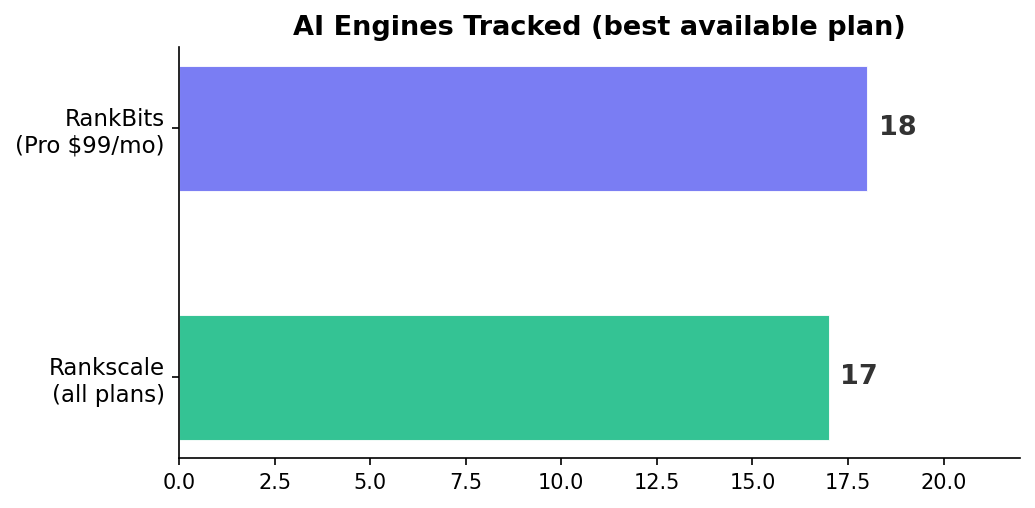
These are the two tools with the broadest engine coverage in the category — and neither charges per-engine add-on fees.
RankBits Pro ($99/month): 18 engines, flat pricing. ChatGPT, ChatGPT Pro, Claude, Claude Pro, Gemini, Gemini Pro, Google AI Overviews, Google AI Mode, Perplexity, Grok, SuperGrok, Bing Copilot, Google Search, Bing Search, DuckDuckGo, Yahoo, Tavily, and Exa.
Rankscale (all plans): 17+ engines, credit-weighted. ChatGPT, Perplexity, Google AI Overviews, Google AI Mode, Gemini, Claude, DeepSeek, Grok, Microsoft Copilot, Mistral, plus model-level APIs (GPT-4o, GPT-5, Gemini 2.0/2.5/3.0, Claude 3.5 Haiku, Sonar-Pro, DeepSeek V3, Mistral Large). All available from the $20 plan.
The key difference: Rankscale covers DeepSeek and Mistral (which RankBits doesn't), plus model-level API tracking. RankBits covers paid-tier assistants (ChatGPT Pro, Claude Pro, Gemini Pro, SuperGrok), traditional search baselines (Google, Bing, DuckDuckGo, Yahoo), and AI-native search APIs (Tavily, Exa) — none of which Rankscale covers.
Feature Radar: Strengths at a Glance
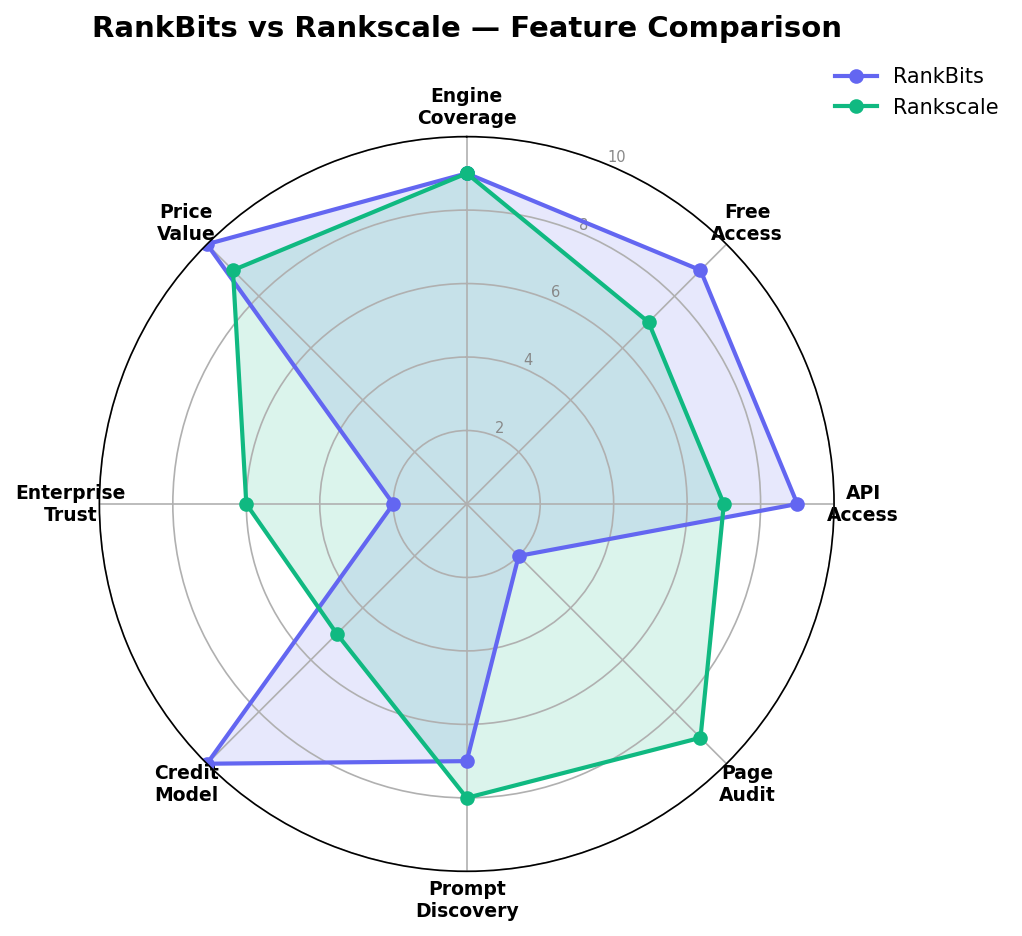
The radar shows two tools with similar engine coverage but very different strengths elsewhere. RankBits leads on pricing predictability and API access. Rankscale leads on page audits, enterprise features, and maturity. Both score well on engine coverage and price value. The credit model is Rankscale's weakest dimension — it's the main friction point users report.
Features: Where Each Tool Actually Wins
Where Rankscale is genuinely stronger
AI Readiness Score (Page Audit V2). This is Rankscale's standout feature. It audits any URL against 200+ checkpoints covering AI bot crawlability, schema markup, content structure, semantic clarity, authority signals, and metadata accuracy. It shows you exactly which AI crawlers can access your pages (GPTBot, ClaudeBot, PerplexityBot, etc.) and flags the ones being blocked. Each recommendation maps to specific tracked prompts where the page underperforms. A free audit is available without signup. RankBits has no equivalent — it tells you where you stand but doesn't audit why your pages aren't being cited.
Credit-based flexibility. Rankscale's credit model has a genuine upside: you can track as many search terms as you want, and credits roll over (up to 2–3× your monthly allocation). If you do a deep-dive one month and go light the next, the credit model accommodates that. RankBits' flat caps are rigid — 50 prompts on Pro, period.
White-label and agency features. Rankscale offers white-labeled dashboard links, an agency partner directory, lifetime affiliate commissions, agency accelerator webinars, and a private Slack channel — all from the Growth plan ($385/month). It's built for agencies managing multiple clients. RankBits has no white-label or agency-specific features.
Unlimited seats on all paid plans. Every Rankscale plan includes unlimited team members with an extensive permissions system. RankBits is built for individual accounts.
Co-founder onboarding. Rankscale's founder, Mathias Ptacek, runs daily 1-hour video onboarding calls available to users at every plan level. Multiple independent reviewers flag this as a genuine differentiator — you get technical depth directly from the person building the product. RankBits offers email support.
Enterprise customers and maturity. Rankscale counts Bosch, UBS, Cartier, O2, Dentsu, Publicis Sapient, and WPP among its customers. It has 1,000+ active users, a 4.6/5 OMR Reviews rating, and was editorially selected by OMR Reviews as a top AI Search Analytics tool. It's been around since 2024. RankBits is a month old.
Looker Studio and Google Sheets integration. Rankscale offers native Looker Studio connector and Google Sheets export on Pro and above. RankBits has CSV/PDF/Excel exports and a REST API, but no Looker Studio connector.
Shopping analysis and query fan-out. Rankscale tracks ChatGPT Shopping results and query fan-out (how AI engines expand your prompts into related searches). RankBits doesn't cover either.
Where RankBits is genuinely stronger
Flat, predictable pricing. RankBits Pro is $99/month — period. You get 50 prompts × 18 engines × 5,000 responses. No credit math, no per-engine weighting, no surprises. Rankscale's credit model means your real cost depends on which engines you track and how often. Claude-heavy tracking can burn credits 8× faster than ChatGPT-only.
Free tier that never expires. RankBits Free is $0 forever — one brand, five prompts, five engines, weekly scans, public shareable reports. Rankscale offers a 7-day free trial and a free one-off AI Readiness Audit, but no ongoing free tier.
API access on every plan. RankBits includes REST API access on Free, Starter, and Pro. Rankscale gates API access behind Growth ($385/month) and Enterprise ($780/month). For developers who want to build custom workflows without a $385/month commitment, RankBits is the only option.
Paid-tier AI assistants. RankBits tracks ChatGPT Pro, Claude Pro, Gemini Pro, and SuperGrok — the paid, upgraded versions of each assistant. Rankscale doesn't differentiate between free and paid tiers.
Traditional search baselines. RankBits includes Google, Bing, DuckDuckGo, and Yahoo search results alongside AI answers. Rankscale is AI-only.
Public shareable reports. Every RankBits scan produces a permanent public URL — no login required. Rankscale offers shareable dashboard links (white-labeled on higher plans) but they stay within the platform.
AI-native search engines. Tavily and Exa — the search APIs powering AI agents and developer tools — are included in RankBits. Rankscale doesn't cover them.
MCP server. RankBits has MCP for querying visibility data from any AI client. Rankscale doesn't offer MCP.
The Honest Limitations of Each
Rankscale's limitations
- Credit model is unpredictable. The $20 sticker price is misleading for multi-engine tracking. Claude costs ~8× more credits than ChatGPT. A realistic setup with 10 prompts across 5 engines daily can easily exceed the Essentials plan. You need to actively manage credit consumption.
- AI Readiness Score is inconsistent. Multiple independent reviewers report that running the same page audit back-to-back produces different scores. The audit recommendations are useful; the numeric score is not reliable enough to report as a KPI.
- No free tier. The 7-day trial and free one-off audit are useful for evaluation, but there's no ongoing free plan. RankBits Free is $0 forever.
- API gated to higher plans. REST API access requires Growth ($385/month) or Enterprise ($780/month).
- No paid-tier assistant tracking. ChatGPT Pro, Claude Pro, and Gemini Pro users may see different recommendations. Rankscale doesn't capture that split.
- No traditional search baseline. You can't compare AI visibility against Google/Bing rankings in Rankscale.
- Dense interface. Multiple reviewers note a learning curve. The dashboards are powerful but not intuitive for beginners.
- Monitoring-only. Like most tools in this category, Rankscale tells you where you stand but doesn't write content or fix the gaps it finds. The Page Audit points at problems; it doesn't solve them.
RankBits' limitations
- No page audit. RankBits shows you visibility data but doesn't audit your pages for crawlability, schema, content structure, or authority signals. Rankscale's 200+ checkpoint AI Readiness Score is genuinely useful and has no RankBits equivalent.
- No white-label or agency features. RankBits is built for individual accounts. Rankscale's agency program with white-label, affiliate commissions, and partner directory is better for agencies.
- No Looker Studio connector. CSV/PDF/Excel exports and API/MCP cover most workflows, but if your reporting stack is Looker Studio-native, Rankscale has the edge.
- No unlimited seats. Built for individual accounts. Rankscale's unlimited seats on all paid plans is better for teams.
- No shopping analysis or query fan-out. Rankscale tracks ChatGPT Shopping and query expansion. RankBits doesn't.
- No DeepSeek or Mistral. Rankscale covers these; RankBits doesn't.
- New and unproven. One month old, bootstrapped, no third-party reviews. Rankscale has 1,000+ users, enterprise customers like Bosch and UBS, and a 4.6/5 OMR rating.
- Smaller prompt caps. Free = 5 prompts, Starter = 20, Pro = 50. Rankscale's credit model lets you track unlimited search terms (you just burn credits faster).
Which Tool Should You Pick?
| You should pick RankBits if… | You should pick Rankscale if… |
|---|---|
| You want flat, predictable pricing — $99/month covers everything, no credit math | You need a page audit — the 200+ checkpoint AI Readiness Score is genuinely useful |
| You want a free tier that never expires — not a trial, not a one-off audit | You want the cheapest possible entry point at $20/month and mostly track ChatGPT |
| You're a developer who wants API access on a free plan without a $385/month commitment | You're an agency that needs white-label, unlimited seats, and affiliate commissions |
| You want to track paid-tier AI assistants (ChatGPT Pro, Claude Pro, Gemini Pro, SuperGrok) | You need DeepSeek and Mistral tracking — Rankscale covers these, RankBits doesn't |
| You want traditional search baselines (Google, Bing) alongside AI visibility | You need Looker Studio connector and Google Sheets export |
| You need public shareable reports and MCP server access | You want co-founder onboarding — daily 1-hour calls with the person building the product |
| You want to track Tavily and Exa — the search layer under AI developer tools | You need shopping analysis (ChatGPT Shopping) and query fan-out tracking |
| You track Claude heavily — Rankscale's 8× credit multiplier makes Claude tracking expensive | You need enterprise credibility — Bosch, UBS, Cartier, and Dentsu are on the customer list |
The Bottom Line
Rankscale and RankBits are the two most similar tools I've compared. Both offer broad engine coverage (17+ vs 18) with no per-engine add-on fees. Both are bootstrapped. Both are built by small teams in Europe. Both sit at the affordable end of the market.
The differences come down to three things:
1. Pricing model. RankBits is flat and predictable. Rankscale is credit-based and flexible — but the real cost can be higher than the sticker price, especially if you track Claude or DeepSeek. If you want to set a budget and forget it, RankBits wins. If you want to burst one month and coast the next, Rankscale's rollover credits are better.
2. Page audits. Rankscale's AI Readiness Score is genuinely useful — it tells you why your pages aren't being cited, not just that they aren't. RankBits has no equivalent. If you need diagnostic depth, Rankscale wins.
3. Who they're built for. Rankscale is built for agencies and teams — white-label, unlimited seats, affiliate commissions, co-founder onboarding. RankBits is built for founders and developers — API on free plan, MCP, public reports, flat pricing. Pick the one that matches how you work.
These tools actually complement each other well. Rankscale tells you why you're not being cited (page audit). RankBits tells you where you're invisible across the broadest set of surfaces at a flat, predictable price. The ideal stack for a serious team might be both: Rankscale for diagnostics, RankBits for breadth.
Want to see where you stand before committing to either? Run a free AI visibility scan — no signup required. Or create a free RankBits account to track your brand across 5 engines weekly, forever.
Sources
This article was researched using the following sources:
- Rankscale — Pricing page
- Rankscale — Facts & Entity Definition
- Max Productive — Rankscale AI Review (2026)
- Marco Diversi — RankScale Review (2026)
- Dageno AI — Rankscale AI Review (2026)
- Rankability — Rankscale AI Review (2026)
- OnMarketing.ai — Rankscale AI Rank Tracking Features
- Analyze AI — Rankscale AI Review (2026)
- OMR Reviews — Rankscale.ai Reviews (4.6/5, 26 reviews)
- Grounding Page — Rankscale Facts
- Best AEO Tools — Rankscale Review (2026)
- HackerNoon — 11 Best GEO Tools (2026)
- Spike AI — Rankscale Alternatives (2026)
- LLM Pulse — Best Rankscale AI Alternatives (2026)
- CheckThat.ai — Rankscale Company Overview
- Latka — Rankscale.ai Revenue & Valuation
- RankBits — Pricing page