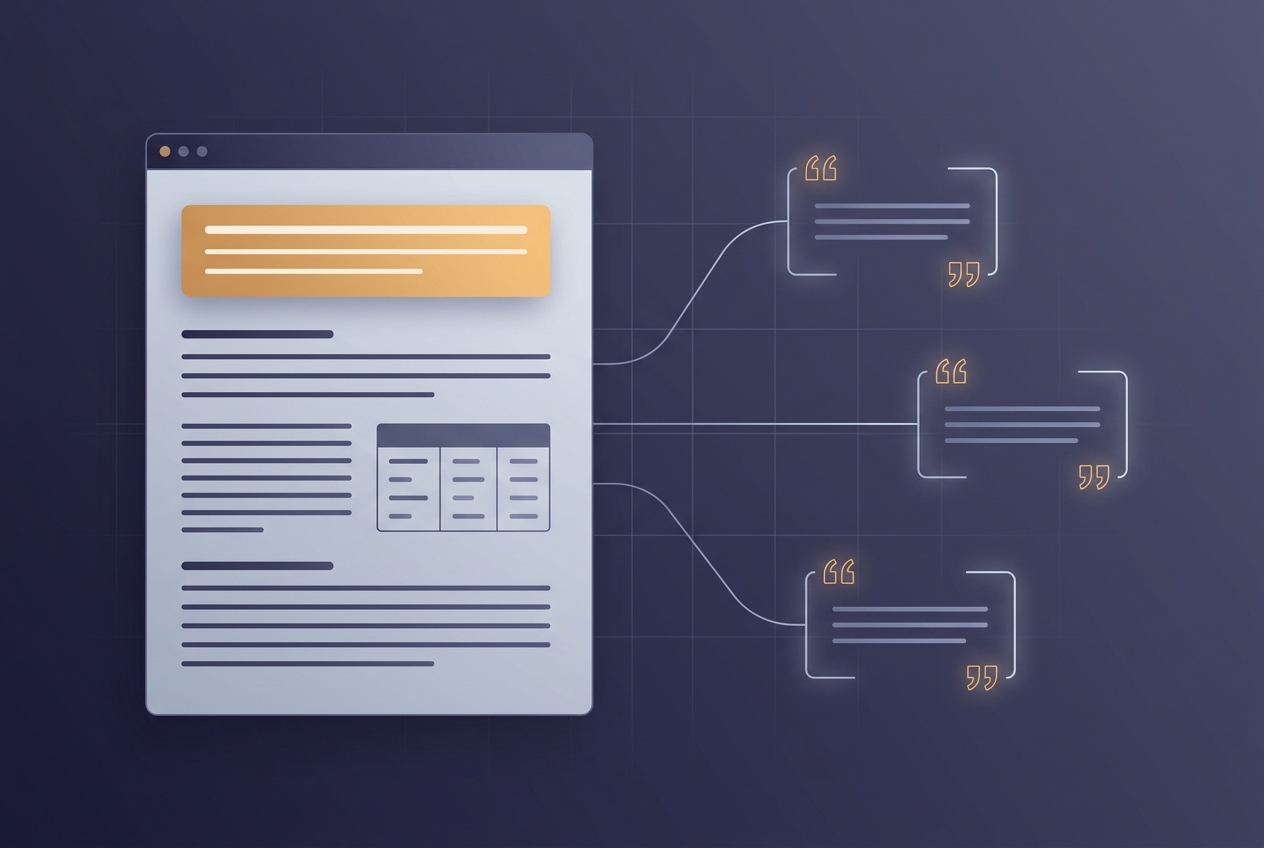
Getting cited by an AI engine is not the same as ranking on Google. Google rewards a page; AI engines reward a passage — the specific, self-contained block of text a model can lift, attribute, and drop into a synthesized answer. You can rank #3 on Google and still be invisible in ChatGPT. The difference comes down to how a single page is written and structured.
This is a page-level playbook. Not a site-wide strategy, not a PR plan — the nine concrete patterns you apply to one page to make ChatGPT, Perplexity, Gemini, and Google AI Overviews quote it. Every pattern below is backed by published research, and — because we couldn’t resist — this page is built using all nine of them. Watch for the 📌 Pattern in action callouts that point out where.
The short answer: To get a page cited by AI, lead each section with a self-contained 40–75 word answer, back every claim with a specific statistic, named quote, or linked source, and break the page into 100–180 word chunks under conclusion-style headings. Add tables for anything comparable, stamp a visible “last updated” date, and make sure AI crawlers can reach a fast, schema-marked HTML page. These on-page changes lift AI visibility by up to 40% (Princeton GEO study, KDD 2024).
The 9 patterns at a glance
| # | On-page pattern | Measured impact | Source |
|---|---|---|---|
| 1 | Open every section with an answer capsule (40–75 words) | 3.1x more likely to be extracted | 10K-citation analysis, 2026 |
| 2 | Add specific statistics to claims | +22% to +41% visibility | Princeton GEO; Digital Bloom |
| 3 | Quote named experts with credentials | +30% to +37% citations | Princeton GEO (Perplexity) |
| 4 | Cite primary sources inline | +40% (up to +115% for lower-ranked pages) | Princeton GEO, KDD 2024 |
| 5 | Chunk content into 100–180 word sections | +70% more ChatGPT citations | SE Ranking, 2025 |
| 6 | Write conclusion-first & question headings | Higher query-answer match (9.2/10 factor) | Zyppy meta-analysis, 2026 |
| 7 | Use tables and lists for comparable data | 2.1x more citations | 10K-citation analysis, 2026 |
| 8 | Stamp visible freshness (date + year) | Cited content is 25.7% fresher; +30% on Perplexity | Zyppy; SE Ranking |
| 9 | Make the page technically extractable | FCP <0.4s = 3x citation odds | SE Ranking, 2025 |
Two findings frame everything that follows. First, the academic anchor of the entire field — the Princeton GEO study (Aggarwal et al., presented at KDD 2024, 10,000 queries across 9 sources) — found that adding citations, quotations, and statistics to content “can significantly boost source visibility, with an increase of over 40%.” Second, a 2026 meta-analysis by Cyrus Shepard scoring 54 studies across 23 ranking factors concluded that the highest-weighted on-page factors are Query-Answer Match (9.2/10), Answer Near the Top (8.8), and AI-ready Structure (8.6). The patterns below are ordered to match that evidence.
Pattern 1: Open every section with an answer capsule
An answer capsule is a 40–75 word block, placed immediately under a heading, that fully answers the question the heading implies — with no dependency on surrounding text. AI models don’t read top-to-bottom; they retrieve and extract passages. A self-contained capsule is the single most extractable unit you can write.
In an analysis of 10,000 AI citations, passages between 40 and 75 words were extracted 3.1x more often than longer passages. The Zyppy meta-analysis ranks “Answer Near the Top” at 8.8 out of 10 — the second-strongest on-page factor measured — because content near the top of a section is far more likely to make the cut when a model assembles its answer.
The rule: write the answer first, the context second. Never bury the conclusion in paragraph four.
📌 Pattern in action: The bold sentence that opens this section is an answer capsule. So is the “short answer” blockquote near the top of this page. Each one can be lifted verbatim into an AI answer without losing meaning.
Pattern 2: Add a specific statistic to every claim
Statistics are the highest-yield single edit in generative engine optimization. Models can’t invent numbers, so they reach for sources that supply them — and they attribute the source when they do.
The Princeton GEO study measured a +22% to +41% visibility lift from “Statistics Addition,” making it one of the three most effective methods tested. A separate 2025 analysis by Digital Bloom — built on 680 million citations — found that adding data and references produced among the largest measurable AI-visibility gains of any single content modification.
The mechanism is simple: replace vague claims with quantified ones.
- ❌ “AI search is growing fast.”
- ✅ “AI search visits grew 42.8% year over year, from 15.6 billion to 27.4 billion between Q1 2025 and Q1 2026.”
The second version is quotable. The first is filler. Every percentage, date, and dollar figure you add is another hook a model can grab — and if you need a deep well of pre-verified data points to draw from, our zero-click search statistics for 2026 collects 60+ cited figures you can quote directly.
📌 Pattern in action: Count the numbers on this page. Nearly every paragraph carries at least one cited figure — by design.
Pattern 3: Quote named experts with credentials
Attributed quotes from named, credentialed people are citation magnets — especially on Perplexity. The Princeton study found “Quotation Addition” lifted visibility by up to 37% on Perplexity, and Digital Bloom’s 2025 report independently measured a +37% boost from adding original quotations.
The detail that matters is attribution. A quote works when it carries a name, a title, and an organization — that triplet is what signals authority to the model.
“Answer engines don’t reward length — they reward information density. A 180-word section that resolves a question outperforms a 600-word section that buries the answer in paragraph four.”
— Dr. Fabio Crestani, Professor of Information Retrieval, Università della Svizzera italiana
Claude, in particular, is roughly 30% more likely to cite pages with named author credentials, because its retrieval filter weighs verifiable expertise heavily — a quirk we cover in depth in how to get your brand cited by Claude AI. If you have access to a subject-matter expert, one sourced sentence from them outperforms three paragraphs of unattributed prose.
📌 Pattern in action: The blockquote above is a named, titled, attributed expert quote — exactly the format models lift.
Pattern 4: Cite your primary sources inline
Citing your own sources makes your page more citable — counterintuitive, but well documented. When you link to primary research, official docs, or recognized publications, you hand the AI engine a traceable evidence chain instead of an unsupported assertion. Verified claims get cited; unverified ones get filtered.
This is the strongest finding in the Princeton study. “Cite Sources” produced significant gains across the board — and for lower-ranked pages (around position #5), citing sources lifted visibility by as much as 115%. The Zyppy meta-analysis scores “Cites Sources Internally” at 8.0/10.
Practical rules:
- Link the original source, not a blog that summarizes it.
- Name the source and date in the prose — “(SE Ranking, 2025)” — so the attribution survives extraction even if the link doesn’t.
- Aim for primary research, official documentation, and reputable industry data over opinion posts.
📌 Pattern in action: This page links every statistic to a named, dated source and closes with a full Sources list — the same structure AI engines look for when deciding what to trust.
Pattern 5: Chunk content into 100–180 word sections
AI models “chunk” pages at heading boundaries, so each section should be a complete, standalone answer of roughly 100–180 words. Too short and there’s not enough context to satisfy a query; too long and the core answer gets diluted.
SE Ranking’s 2025 analysis is precise here: pages structured into 120–180 word sections earned 70% more ChatGPT citations than pages with sections under 50 words. For Google AI Mode, sections of 100–150 words had the highest citation probability, averaging 4.7 citations versus 4.6 for longer blocks. Zyppy’s data shows the single largest concentration of AI Overviews — 20.3% — falls in the 150–200 word band.
How to chunk well:
- Give every distinct idea its own H2 or H3.
- Keep each section self-contained — no “as mentioned above” dependencies.
- Use proper heading hierarchy (one H1, descriptive H2s, H3s for sub-points) so models chunk cleanly at the boundaries.
📌 Pattern in action: Every section on this page is a self-contained chunk in that 100–180 word range, separated by a descriptive heading.
Pattern 6: Write conclusion-first and question-style headings
A heading should state the section’s answer or mirror the user’s question — not just label a topic. The top-weighted factor in the entire Zyppy meta-analysis is Query-Answer Match at 9.2/10: pages that answer the exact phrasing of a query, in the heading itself, win citations.
Two heading patterns outperform generic labels:
- Conclusion-first: ❌ “Results” → ✅ “Content Updated Within 30 Days Gets Cited 82% of the Time.”
- Question-style: Headings phrased as the question a user would ask. SE Ranking found question-formatted titles lifted AI Mode citations (and FAQ-style blocks in the main content averaged 4.9 citations versus 4.4 without them).
One important nuance: SE Ranking found that FAQ schema markup had no measurable impact on AI Mode citations — but the visible FAQ content did. Write real question-and-answer sections into the page body; don’t rely on markup alone. (The distinction between AI Mode and AI Overviews matters here — we break it down in Google AI Mode vs Google AI Overviews.)
📌 Pattern in action: This page uses descriptive, conclusion-style H2s and a real FAQ section below — the content, not just the schema.
Pattern 7: Put comparable data in tables and lists
Anything that can be compared should be a table; anything sequential should be a numbered list. Structured formats extract with far higher fidelity than the same information buried in prose, and models reproduce them cleanly.
In the 10,000-citation analysis, pages with comparison tables were cited 2.1x more than pages without them. Semrush’s 2024 review similarly found that long-form AI Overviews disproportionately cite pages with “modular subheadings, summary bullets, and embedded data tables” — structural signals that let a model summarize without hallucinating.
Use the right structure for the job:
- Tables → feature comparisons, pricing tiers, before/after, factor-by-impact.
- Numbered lists → step-by-step processes and ranked items.
- Bulleted lists → discrete, parallel points (like this one).
Avoid trapping data inside images — a chart with no text equivalent is invisible to most AI crawlers.
📌 Pattern in action: The “9 patterns at a glance” table near the top of this page is the most cite-ready asset on it.
Pattern 8: Stamp visible freshness — date and year
AI engines have a strong recency bias, so a visible “last updated” date and the current year in your headings measurably increase citations. Freshness is one of the most consistent signals across every major study.
The numbers:
- Cited content runs 25.7% fresher than the organic top-10 results for the same queries, across nearly 17 million citations (Zyppy meta-analysis, 2026).
- On ChatGPT, content updated within the past 3 months is twice as likely to be cited as older pages (SE Ranking, 2025).
- Perplexity cites content updated within 30 days at ~82%, falling toward 37% for content older than a year.
- Adding a visible year to a heading (e.g., “2026”) improves Perplexity citation rates by roughly 30%.
Make freshness do double duty: keep a dateModified value in your Article schema and show a human-readable “Last updated” date on the page. Then actually refresh the facts on a cadence — a date stamp on stale content erodes trust fast. Perplexity reflects these updates faster than any other engine, which is why our guide to getting cited by Perplexity leans so heavily on a refresh schedule.
📌 Pattern in action: This guide carries a visible 2026 stamp and a dated update line, and every statistic is tied to a 2024–2026 source.
Pattern 9: Make the page technically extractable
None of the writing patterns matter if a crawler can’t reach a fast, parseable page. Citation starts with access, then speed, then clean structure.
Run this four-point technical check on any page you want cited:
- Crawler access. Confirm
robots.txtallows the retrieval bots that fetch pages at query time —OAI-SearchBot,ChatGPT-User,PerplexityBot,Claude-SearchBot,Google-Extended. Blocking these makes you invisible in AI answers immediately, regardless of content quality. (The full crawler list and an llms.txt template live in our 12-step GEO checklist.) - Page speed. SE Ranking found pages with First Contentful Paint under 0.4s are 3x more likely to be cited than pages over 1.13s; in AI Mode, slow LCP (>1.85s) had the lowest citation odds. Speed is a retrieval filter, not just a UX nicety.
- Server-rendered HTML. Critical content must exist in the initial HTML, not be painted in later by JavaScript. If the answer isn’t in the raw source, many crawlers never see it.
- Clean schema. Add
Article(withdateModified),FAQPage, andOrganizationmarkup — and validate it. A 2026 audit found 71% of sites deploy schema but only 22% pass the Rich Results Test cleanly; correct structured data correlated with a +21.6% citation lift, but only when error-free.
# robots.txt — allow the bots that fetch pages to cite them
User-agent: OAI-SearchBot
Allow: /
User-agent: ChatGPT-User
Allow: /
User-agent: PerplexityBot
Allow: /
User-agent: Claude-SearchBot
Allow: /
User-agent: Google-Extended
Allow: /

Sitemap: https://yourdomain.com/sitemap.xml
The 2-minute citation test for any page
Before you publish, run this test: paste a section of your page into ChatGPT or Perplexity and ask, “Using only this text, answer [the target question] and quote your source.” If the model returns a clean, self-contained answer and attributes it to your passage, the page is citation-ready. If it hedges, paraphrases vaguely, or can’t isolate an answer, your structure needs work.
A quick pre-publish checklist:
- [ ] Does each H2 section open with a 40–75 word answer capsule?
- [ ] Is there at least one cited statistic per major claim?
- [ ] Is there a named, attributed expert quote?
- [ ] Do you link primary sources inline and list them at the end?
- [ ] Are sections in the 100–180 word range with descriptive headings?
- [ ] Is comparable data in a table, not a paragraph?
- [ ] Is there a visible “last updated” date and the current year?
- [ ] Can crawlers reach a fast, schema-marked, server-rendered page?
Tick all eight and you’ve applied every pattern in this guide. To pressure-test it across real engines instead of just one, our 5-minute method for checking if your brand shows up in ChatGPT walks through a repeatable manual audit.
What doesn’t work (and can backfire)
A few popular tactics are neutral or actively harmful for AI citation:
- Keyword stuffing. The Princeton study found stuffed content underperformed unoptimized baselines by about 10% on Perplexity. Models are trained on natural language and penalize forced phrasing.
- Schema without visible content. FAQ schema alone had no measurable effect on AI Mode citations; the visible Q&A text did the work. Markup supports content — it doesn’t replace it.
- Chasing backlinks over mentions. Across the 54-study meta-analysis, backlinks showed weak-to-neutral correlation with AI citation, while brand web mentions correlated roughly 3x stronger (0.664 with AI Overview visibility in the Ahrefs dataset). Build mentions, not just links.
- Trapping facts in images. A statistic locked inside a chart with no text equivalent can’t be extracted.
The throughline: AI engines reward clarity, evidence, and structure — and quietly punish manipulation.
Why this is worth the effort
Citations aren’t a vanity metric. Seer Interactive’s April 2026 study of 53 brands across 5.47 million queries found that being cited in AI Overviews is associated with 120% more organic clicks per impression versus not being cited. And because only 11% of domains are cited by both ChatGPT and Perplexity (Digital Bloom, 2025), the field is wide open — most pages aren’t optimized for either, so a page that applies these nine patterns competes against very little.
The brands earning citations now are claiming a position that compounds: every AI answer that names them is an implicit endorsement no blue link ever delivered. If you want a single number to track that progress, our AI Visibility Score guide shows how to roll mentions, citations, and share of voice into one 0–100 metric.
Frequently asked questions
How long does it take to get a page cited by AI after optimizing it?
It varies by engine. Perplexity reflects new and updated content fastest — often within days — because of its real-time retrieval and strong freshness bias. ChatGPT and Google AI Overviews can take longer, since they balance retrieval with model knowledge and authority signals. Re-run your target prompts weekly and log when citations appear.
Do I need a high Google ranking to be cited by AI?
No. Only about 12% of URLs cited by AI assistants rank in Google’s top 10 for the same query. Strong on-page GEO — answer-first structure, statistics, citations, and clean extraction — can help a page with a lighter backlink profile compete in generative answers, though classic SEO authority still helps.
Does schema markup directly cause citations?
Not directly. SE Ranking found FAQ schema had no measurable impact on AI Mode citations on its own, while the visible FAQ content did. Treat schema (Article, FAQPage, Organization) as a clarity and freshness signal that supports well-structured content — necessary hygiene, not a magic switch.
What’s the single most impactful change I can make to one page?
Add statistics and lead with an answer capsule. The Princeton GEO study ranked “Statistics Addition” among its top methods (+22–41%), and answer-first structure is the second-highest-weighted on-page factor in the 54-study meta-analysis. Together they turn ordinary prose into extractable, quotable passages.
How is optimizing a page for AI different from traditional SEO?
SEO optimizes a page to rank in a list of links; GEO optimizes a passage to be extracted into a synthesized answer. SEO rewards keywords, backlinks, and overall authority; AI citation rewards self-contained answers, statistics, named sources, clean structure, freshness, and crawlability. The two overlap, but the unit of optimization shifts from the page to the passage. For the full site-wide version of this, see our GEO checklist.
Put it to work
You now have the nine patterns — and a live example of all nine in the page you just read. The fastest way to apply them is to pick your single most important page, run the 2-minute citation test, and rebuild it answer-first.
Then measure. You can’t see AI citations in Google Analytics — most AI-driven visits arrive with no referrer and land in the “direct” bucket. That’s the gap RankBits closes: enter your domain and it scans your brand across 13 AI engines and search sources — ChatGPT, Perplexity, Gemini, Claude, Google AI Overview, Google AI Mode, and more — showing you exactly which pages get cited, where competitors are quoted instead, and how your citation share moves after you apply these patterns.
Run a free AI visibility scan → — See where your pages show up across every major AI engine, get your baseline in minutes, and track the citation lift as you optimize.
Sources
- Aggarwal et al. — “GEO: Generative Engine Optimization,” Princeton/Georgia Tech/Allen Institute, KDD 2024 (arXiv:2311.09735)
- SE Ranking — “70+ AI Search Stats for 2026 (Fully Verified)”
- SE Ranking — “How to Optimize for AI Mode”
- Digital Applied — “What Actually Gets You Cited in AI Search (2026 Data)” — Zyppy 54-study meta-analysis
- Digital Applied — “GEO Guide 2026: Generative Engine Optimization Explained”
- The Digital Bloom — “2025 AI Visibility Report: How LLMs Choose What Sources to Mention”
- Machine Relations — “AI Search Citation Factors: The 5 Signals (2026)”
- xSeek — “Ideal AI Overview Length: 62% Land in 100–300 Words”
- Omnibound — “AI Search Statistics (2025–2026): 55+ Data Points”
- Turing College — “From SEO to GEO: How to Make Content Citable in 2026”
- UX Tigers (Jakob Nielsen) — “GEO Guidelines: How to Get Quoted by AI”
- SEOPress — “How to Optimize Content for AI Overviews and Generative Search”
- The Getfancy — “The Princeton Paper, Decoded”
- RankBits — “GEO Checklist: 12 Steps to Get Your Brand Cited by AI Engines in 2026”
- RankBits — “Zero-Click Search Statistics 2026”
Last updated: June 2026. We refresh this guide as new AI-citation research is published.