Your buyers don’t all use the same AI assistant. Some ask ChatGPT, some see a Google AI Overview, some use Perplexity, Gemini, Claude or Copilot. Most brands only check one of them, usually ChatGPT, and assume the others behave the same way.
They don’t. RankBits asks the same buyer questions to many AI engines at once, so we can compare them directly. For this study we took 895 questions that were asked to six engines in the same scan, plus larger paired samples for each engine against ChatGPT, collected between June and November 2026.
The short version:
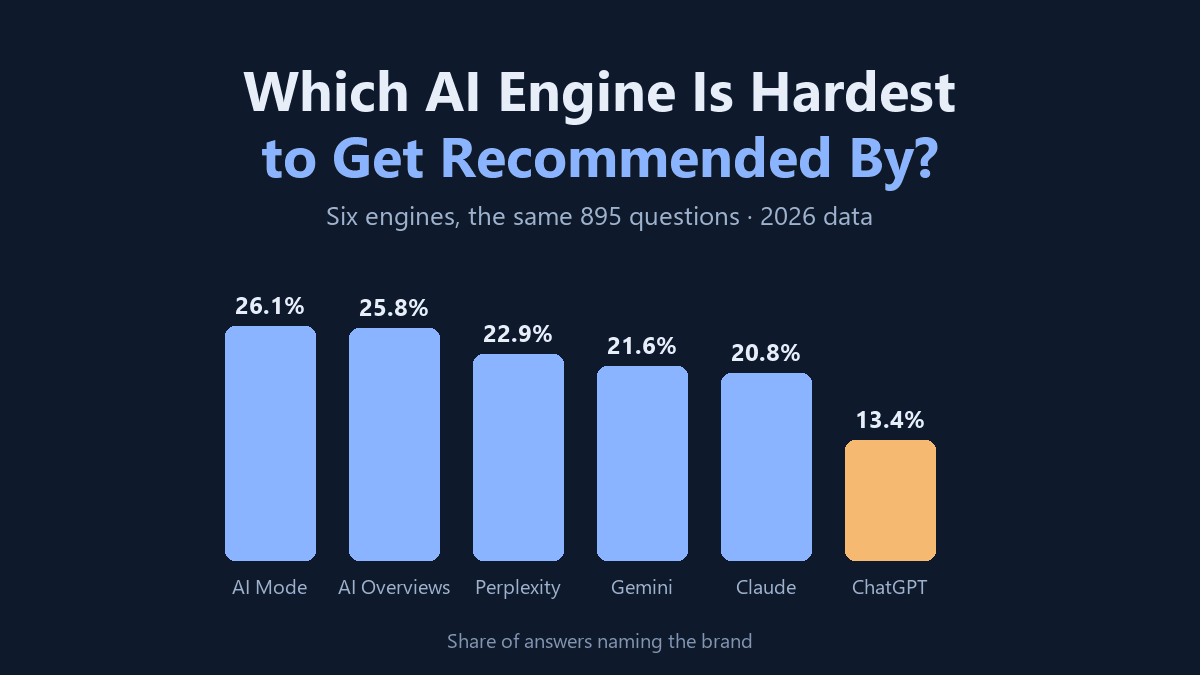
- ChatGPT is the hardest engine to get recommended by. On the same 895 questions, it named the brand in 13.4% of answers. Google AI Mode named it in 26.1%, Google AI Overviews 25.8%, Perplexity 22.9%, Gemini 21.6% and Claude 20.8%.
- Being visible on one engine says little about the others. The brand was named by all six engines on only 5.7% of questions, and by none of them on 57%.
- One thing lifted visibility on every engine: ranking in Google’s top 10 for the question. Brands that did were named about 3 to 3.7 times as often, on every engine we measured.
- Each engine reads different places. YouTube shows up for Google’s engines and Perplexity, but barely for ChatGPT. Reddit and Wikipedia show up for ChatGPT. Claude cites neither community platform.
How we compared the engines
Method and limits
- Data: RankBits scans run between 18 June and 3 November 2026. Scheduled re-runs were excluded. Only prompts that don't contain the brand's name were counted, because every engine names a brand when asked about it directly.
- Same-question set: 895 prompts answered by all six engines (ChatGPT, Google AI Overviews, Google AI Mode, Gemini, Perplexity, Claude) in the same scan, covering 25 brands. That set is small because AI Mode, Gemini and Claude are on paid RankBits plans. So we also report each engine paired with ChatGPT on every prompt both answered, which gives samples of 500–2,150 prompts per engine.
- How answers were collected: ChatGPT, Gemini, Perplexity and Claude were queried through their developer APIs with web search switched on. Google AI Overviews, Google AI Mode and Microsoft Copilot were captured from their live results pages. API answers can differ from the consumer apps.
- "Named" means the brand's name appears in the answer. "Sources" means the web pages an engine cited. For ChatGPT, it also includes every page its search tool consulted, so ChatGPT's source lists are much longer. We compare source shares within each engine, not raw counts across engines.
- Known gaps: about 2–5% of Google AI Overview and AI Mode citations were Google redirect links that we hadn't resolved to the real page yet, so "brand's own site" is slightly undercounted for those two. Grok is excluded because its sample was too small. The brands are self-selected, mostly small and mid-size software companies, not a random sample of the web.
- Privacy: all figures are aggregated, and no customer brand is named.
Finding 1: ChatGPT names brands about half as often as Google's AI engines
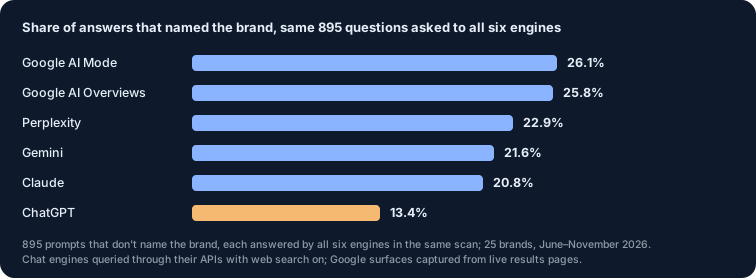
The larger paired samples tell the same story. On every prompt that both ChatGPT and another engine answered, the other engine named the brand more often:
| Engine | Named the brand | ChatGPT, same prompts | Prompts compared |
|---|---|---|---|
| Microsoft Copilot | 36.8% | 30.2% | 503 |
| Google AI Overviews | 26.6% | 18.7% | 2,151 |
| Google AI Mode | 24.9% | 16.8% | 1,186 |
| Claude | 24.1% | 17.1% | 1,167 |
| Gemini | 23.1% | 16.7% | 1,195 |
| Perplexity | 20.2% | 14.2% | 1,779 |
The Copilot rows come from Pro scans, whose brands were more visible overall. That is why both columns are higher there. The gap with ChatGPT is what matters.
Why is ChatGPT harder? The clearest clue is what happens when an engine does not pull in the brand’s own website:
| Engine | Named when the brand's site was among its sources | Named when it wasn't |
|---|---|---|
| ChatGPT | 76.9% | 3.4% |
| Perplexity | 63.1% | 7.5% |
| Google AI Mode | 100% | 11.3% |
| Claude | 87.6% | 12.1% |
| Google AI Overviews | 92.2% | 14.7% |
| Gemini | 85.6% | 15.3% |
| Microsoft Copilot | 100% | 17.5% |
Every engine names brands far more often when it has read their site. But Google’s engines, Claude and Copilot still name brands in 11–18% of answers without citing them. That suggests they draw on what they already know, or on other pages. ChatGPT almost never does: if its search doesn’t bring back your site, it rarely names you. For ChatGPT, getting retrieved matters more than for any other engine. We covered how to do that in our ChatGPT recommendation guide.
The kind of question widens the gap. On “how do I…” questions, ChatGPT named the brand in 8.9% of answers. Google AI Overviews named it in 22.4%, and Gemini, Claude and AI Mode in about 18%. ChatGPT tends to answer how-to questions with a method. Google’s engines more often name tools along the way.
Finding 2: visibility on one engine doesn't carry over to the others
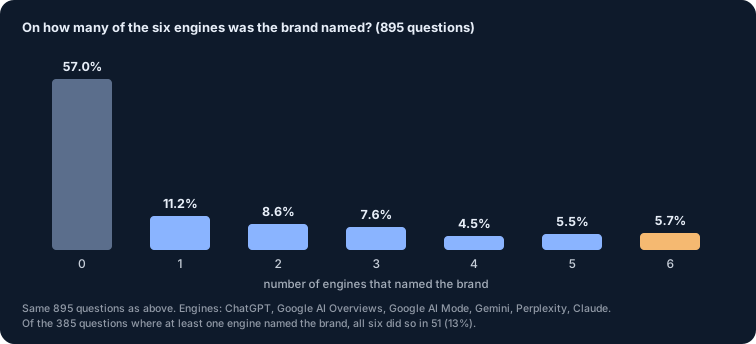
If the engines mostly agreed, checking one would tell you about the rest. They don’t:
- 57% of questions got the brand named by no engine.
- Of the 385 questions where at least one engine named the brand, only 51 (13%) got it named by all six.
- Take Google AI Overviews and ChatGPT on the same 2,151 prompts. Both named the brand on 12.7% of them. AI Overviews alone named it on 13.9%, and ChatGPT alone on 6.0%. Each engine had wins the other missed.
Practical consequence: a brand that checks only ChatGPT will miss most of its wins on Google’s AI surfaces. A brand that checks only Google will miss what ChatGPT says. Measure each engine your buyers actually use.
Finding 3: one lever works on every engine: rank in Google's top 10
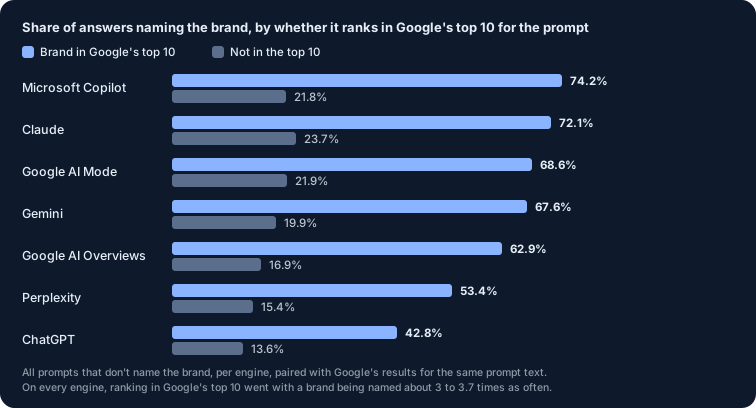
This was the most consistent pattern in the whole dataset. On every engine, including Copilot, which runs on Bing, and Claude, brands that ranked in Google’s top 10 for the question were named about 3 to 3.7 times as often as brands that didn’t.
It isn’t proof that ranking causes recommendations. A strong, relevant page probably drives both. But no other single factor in our data moved every engine at once. If you can only work on one thing for AI visibility across the board, work on ranking for the questions your buyers ask. In our ChatGPT study, the effect held within the same brand: a brand’s top-10 prompts were named about twice as often as its other prompts.
Finding 4: each engine reads different places
Share of each engine’s sources, by type:
| Engine | YouTube | Wikipedia | Review sites (G2, Capterra…) | Brand's own site | Competitors' sites | |
|---|---|---|---|---|---|---|
| ChatGPT | 15.1% | 0.2% | 5.7% | 0.4% | 2.5% | 8.7% |
| Perplexity | 6.2% | 7.7% | 0% | 0.5% | 3.2% | 7.5% |
| Google AI Overviews | 4.3% | 9.9% | 0% | 0.3% | 3.2% | 5.7% |
| Google AI Mode | 4.5% | 10.7% | 0% | 0.4% | 2.1% | 5.8% |
| Gemini | 1.9% | 5.2% | 0% | 0.6% | 3.7% | 4.4% |
| Claude | 0% | 0% | 0% | 0.4% | 4.5% | 6.2% |
| Microsoft Copilot | 0% | 0.2% | 0% | 0.3% | 8.1% | 6.3% |
The rest of each engine's sources, between 67% and 89%, were ordinary websites: publications, blogs, vendor pages and directories. About 15% of Copilot's sources were links to Bing's own results.
The patterns are clear enough to act on:
- YouTube matters for Google’s engines and Perplexity, where it is 5–11% of sources, and hardly at all for ChatGPT, Claude or Copilot. If your buyers see Google AI Overviews, a short video answering a category question can earn a citation that a blog post wouldn’t.
- Reddit and Wikipedia are mostly a ChatGPT thing. Reddit is 15% of what ChatGPT reads, against 4–6% for Google’s engines and Perplexity, and 0% for Claude. Wikipedia appears almost only in ChatGPT.
- Claude and Copilot lean on the open web and on brands’ own sites. Copilot had the highest share of brand-site citations, at 8.1%. Neither cited Reddit, and YouTube barely appeared.
- Review sites barely appear anywhere, at 0.3–0.6% on every engine. They may still matter to buyers directly, but they aren’t how AI engines learn about you, at least for the software-heavy brands in this sample.
What to do about it, engine by engine
Start with what works everywhere, then add the engine-specific work for the engines your buyers use.
Everywhere, first:
- Rank for your buyers’ questions on Google, and on Bing. It is the one lever that moved every engine in our data.
- Make your own site the clearest explanation of what you do. On every engine, being among the sources went with being named. State your category, audience and pricing in plain text.
- Track every engine your buyers use. With all six engines agreeing on only 13% of the questions where any of them named a brand, one engine tells you little about the rest.
Then, per engine:
| Engine | What our data says to prioritise | Guide |
|---|---|---|
| ChatGPT | Get your site retrieved: rank for the short queries ChatGPT rewrites questions into, on Bing as well as Google. Be present in honest Reddit discussions; earn third-party mentions | ChatGPT guide |
| Google AI Overviews & AI Mode | Google rankings first, then YouTube videos that answer category questions. How-to content works here, unlike on ChatGPT | AI Overviews playbook |
| Gemini | Google rankings, clear pages on your own site, YouTube | Gemini guide |
| Perplexity | On the same 895 questions, it pulled in the brand's own site more often than the other five engines (24% of answers). Keep pages fresh and specific; YouTube and Reddit both appear | Perplexity guide |
| Claude | Strong pages on your own site and on independent publications. Community platforms didn't appear in its sources at all | Claude guide |
| Microsoft Copilot | Bing rankings; it cited brands' own sites more than any other engine | GEO checklist |
See which engines name your brand, which name your competitors instead, and where you rank on Google and Bing for each question. Start with the free AI visibility checker, with no account needed, or track one brand weekly for free across ChatGPT, Google AI Overviews, Perplexity and more.
Frequently asked questions
Which AI engine should I optimise for first? The one your buyers use. If you don’t know, start with Google rankings for your buyers’ questions. That went with higher visibility on every engine in our data, and it also feeds Google’s own AI surfaces directly.
Why does ChatGPT recommend my competitors but not me? In our data, ChatGPT rarely named a brand unless its search pulled in that brand’s site: 3.4% of answers without the site among its sources, against 76.9% with it. Check whether you rank for the short queries ChatGPT turns the question into, and whether your site states clearly what you do.
If I’m visible in Google AI Overviews, am I visible in ChatGPT? Not necessarily. On the same prompts, AI Overviews named the brand without ChatGPT doing so on 13.9% of prompts, more than the 12.7% where both did.
Do review sites like G2 help AI visibility? They made up under 1% of sources on every engine in our sample. They may matter for buyers, but they aren’t a main route into AI answers.
Sources
- RankBits scan data: 895 prompts answered by six engines in the same scan (25 brands), plus engine-versus-ChatGPT pairs of 503–2,151 prompts, from 18 June to 3 November 2026. Aggregated and anonymised; method and limits are described in the collapsible section above.
- Related RankBits research: How to Get Your Brand Recommended by ChatGPT (2,309 ChatGPT answers, including the same-brand ranking check) and What Does ChatGPT Actually Cite?