Google AI Overviews now appear on 48% of all search queries — up 58% year over year. When they appear, the #1 organic result loses 58% of its clicks. But there’s a flip side: brands cited inside those AI summaries earn 35% more clicks than uncited competitors. Being cited isn’t just a vanity metric — it’s the difference between visibility and invisibility.
This article breaks down exactly what moves the needle, backed by Google’s own documentation and the latest independent research. No guesswork, no “AI optimization” grift — just what the data says.
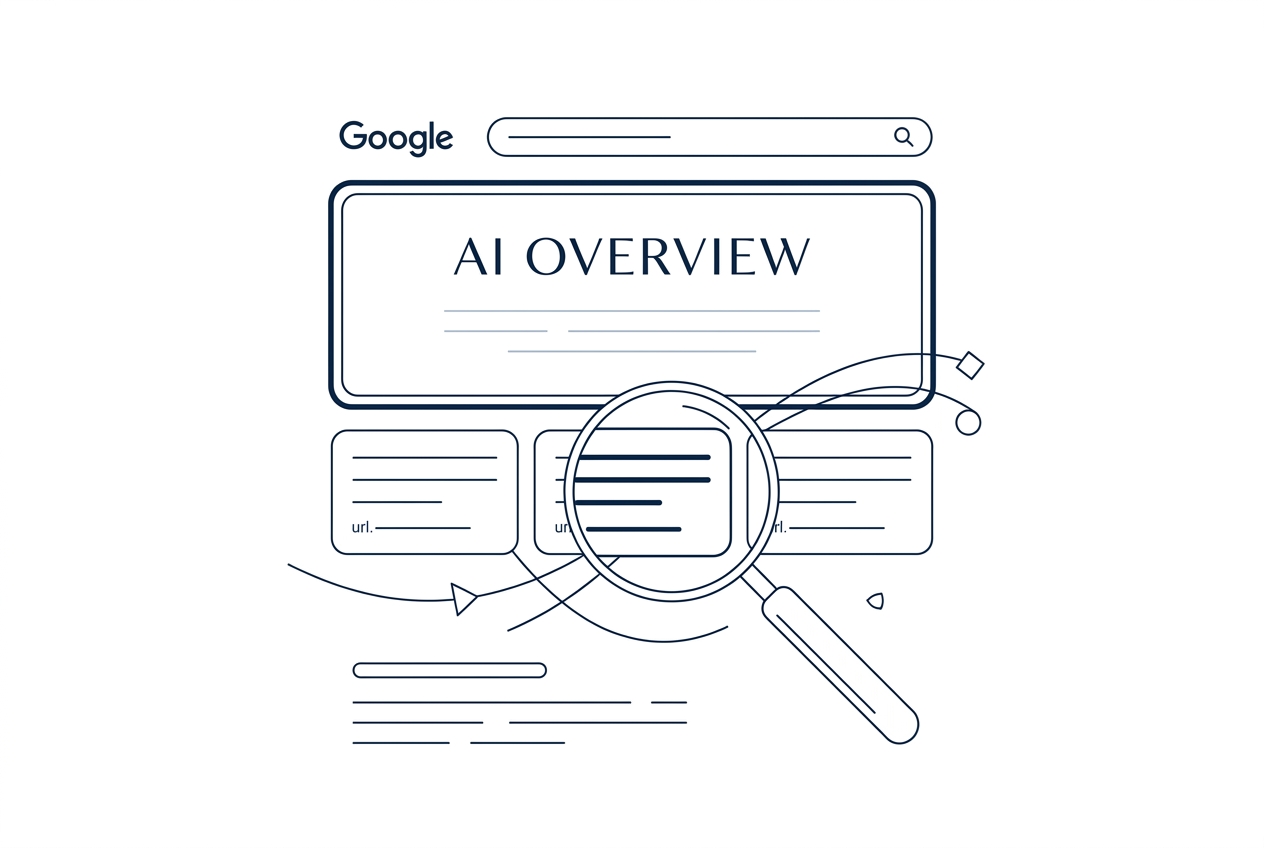
What are Google AI Overviews (and AI Mode)?
Google now runs two distinct AI-powered search features:
AI Overviews appear automatically at the top of standard search results when Google’s systems determine an AI-generated summary adds value. They’re designed for quick answers: definitions, how-tos, comparisons, and fact-finding. Users don’t opt in — Google decides when to show them.
AI Mode is a separate, user-initiated chat-style search experience. Users actively choose it for complex, multi-step queries that need reasoning, comparisons, or exploration. It produces responses roughly 4× longer than AI Overviews, with significantly higher citation rates (97% vs 89%).
Both features use a technique Google calls “query fan-out” — issuing multiple related searches across subtopics and data sources to build a response. This means a single AI answer can surface a wider and more diverse set of links than classic search ever did.
As Google puts it: “These features offer unique opportunities for more types of sites to appear.” [¹]
The scale of the shift
AI Overviews have gone from an experiment to a dominant search feature in under two years:
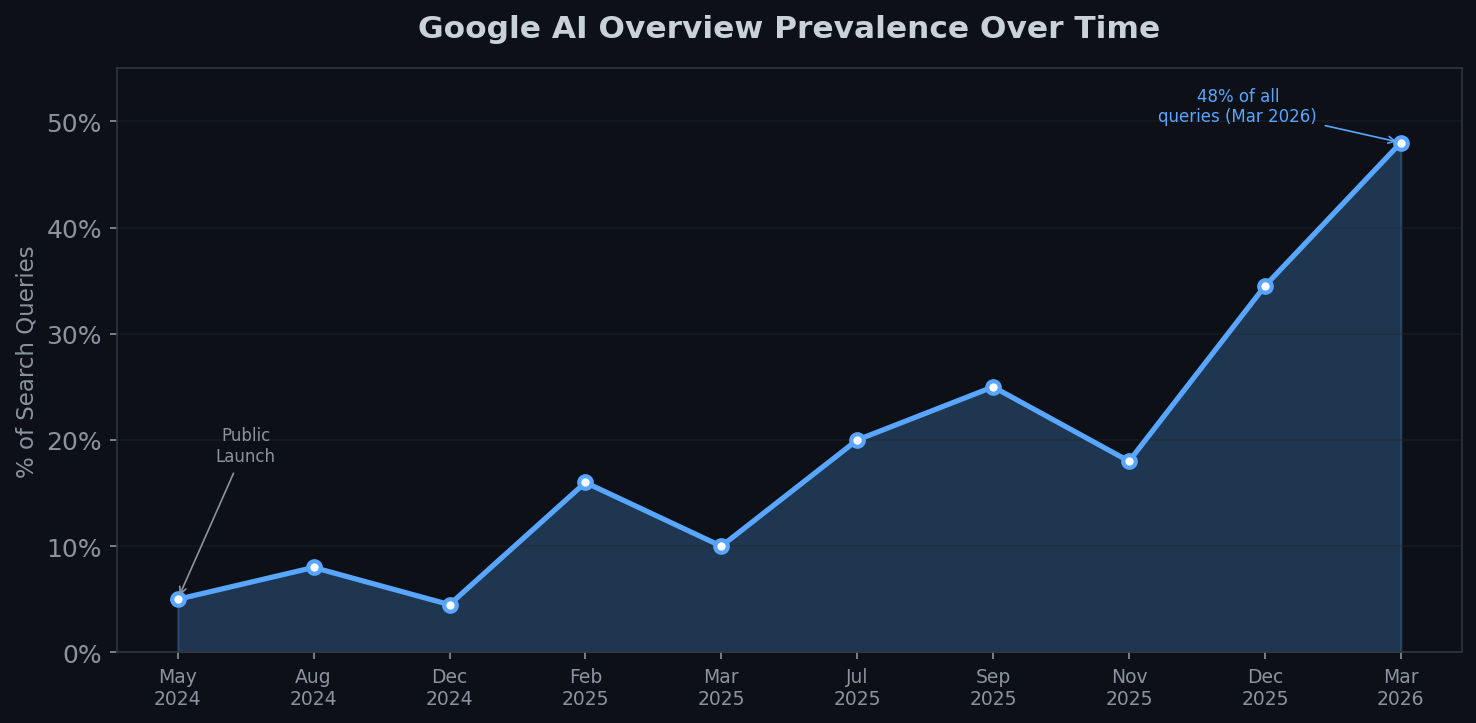
The prevalence varies dramatically by industry. If you’re in healthcare, education, or B2B tech, AI Overviews are nearly ubiquitous:
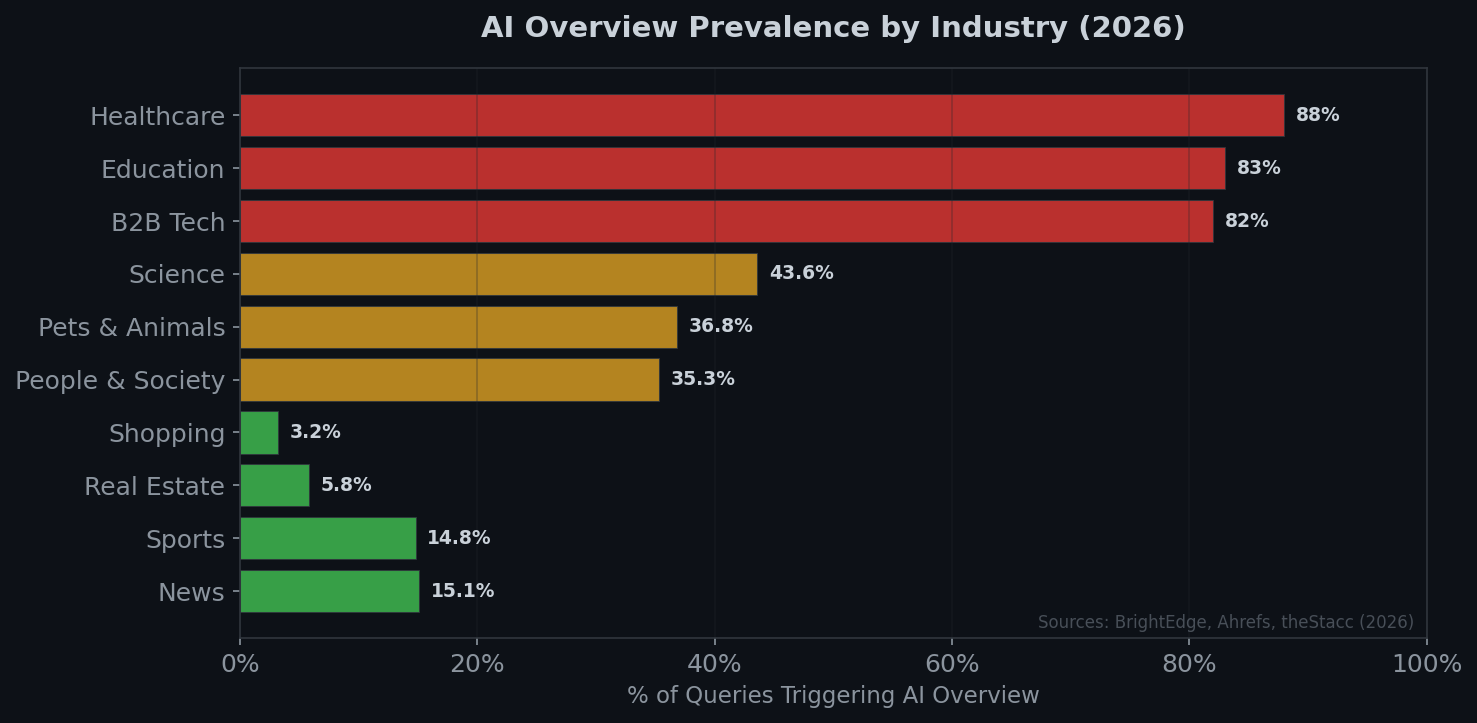
Key stats at a glance:
| Metric | Figure | Source |
|---|---|---|
| Queries triggering AI Overviews | 48% (Mar 2026) | BrightEdge / Advanced Web Ranking |
| Zero-click rate (all searches) | 60% | Similarweb / SparkToro |
| Position 1 CTR drop when AIO present | -58% | Ahrefs (300K keywords, Dec 2025) |
| CTR drop across all positions | -34% to -61% | Seer Interactive |
| Brands cited earn | +35% more clicks | Seer Interactive |
| AIOs citing top-10 organic results | 99.5% | seoClarity (432K keywords) |
| AIO–organic ranking overlap | 54.5% | BrightEdge |
The convergence between organic rankings and AI Overview citations has been steadily increasing — from 32.3% at launch (May 2024) to 54.5% today. Your SEO work is now pulling double duty. [²]
The CTR crisis — and why citations matter more than ever
When an AI Overview appears, clicks to traditional results collapse. Ahrefs’ massive December 2025 study of 300,000 keywords quantified exactly how badly:
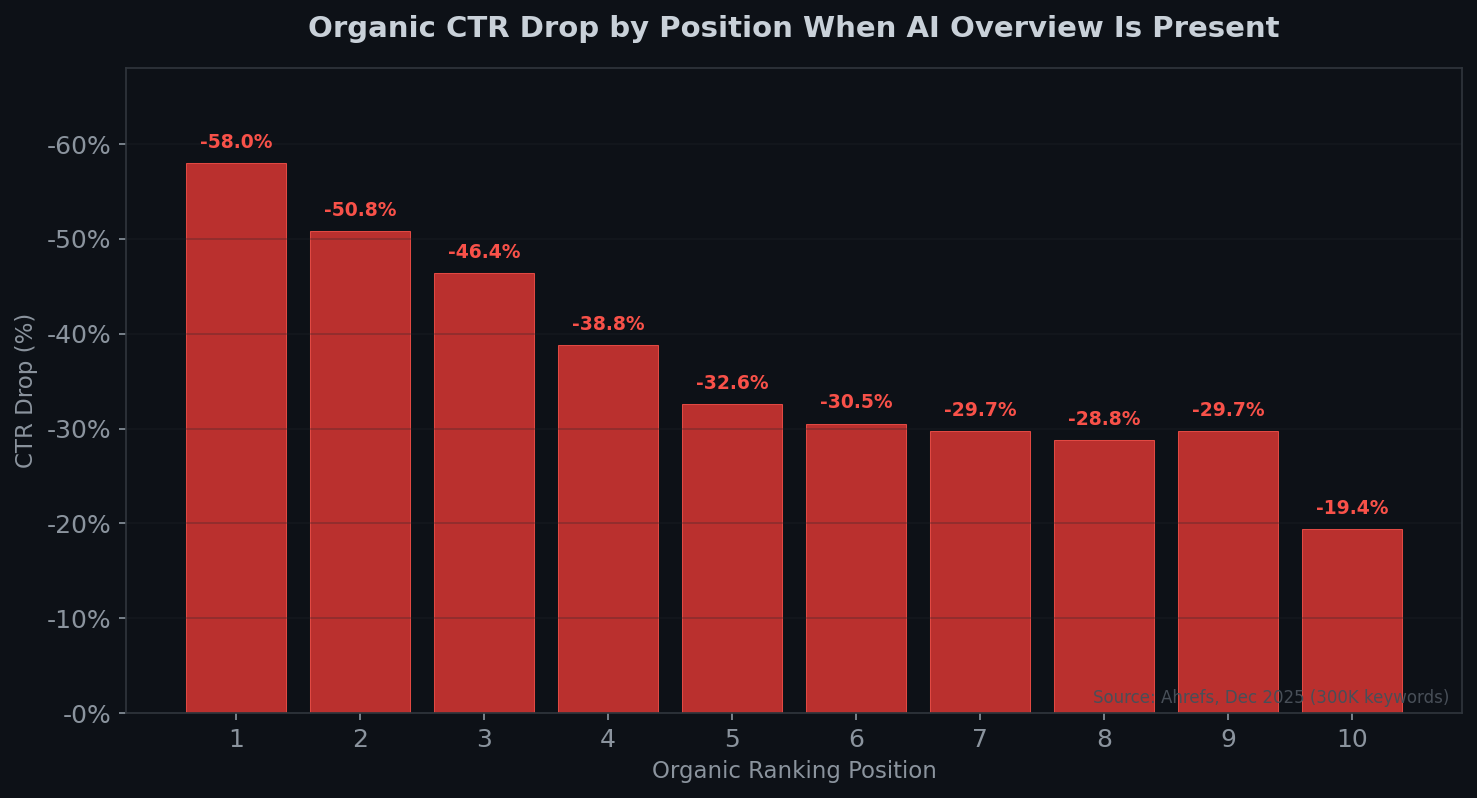
Position 1 goes from roughly 39.8% CTR (clean SERP) to under 20%. Positions 2–5 each lose a third to half of their clicks. This isn’t a temporary dip — it’s structural. [³]
But here’s the counterintuitive finding from Seer Interactive’s 18-month longitudinal study: cited brands buck the trend. When your brand appears as a source in the AI Overview, your organic CTR is 73% higher than when you rank but go uncited (0.95% vs 0.55% in December 2025). The citation is the new ranking. [⁴]
And Google itself confirms: clicks originating from AI Overviews are “higher quality — meaning, users are more likely to spend more time on the site.” [¹]
How to actually get cited: the 7-factor playbook
Every study converges on the same finding: there’s no special “AI optimization.” The same SEO fundamentals that earn top organic rankings are what earn AI Overview citations. But some tactics carry more weight than others.
1. Rank in the top 10. Seriously.
This is the strongest correlation in the data — and it keeps getting stronger.
- seoClarity: 99.5% of AI Overview citations come from top-10 organic results. 97% cite at least one source from the top 20. [⁵]
- BrightEdge: 54.5% of AI Overview citations now also rank organically for the same query, up from 32.3% at launch. [²]
- GAIN/ThisIsGain: 75% of AI Overview citations come from the top 12 organic rankings. [⁶]
The implication is uncomfortable but clear: if you can’t crack the first page of Google, you’re effectively invisible to AI Overviews too. There is no “AI SEO” that bypasses traditional SEO.
2. Structure content for extraction
AI Overviews don’t “read” pages — they extract answer-shaped content from them. Research from SE Ranking and Evergreen Media found that 40–61% of AI Overviews contain bullet points, numbered lists, or step-by-step instructions. [⁷][⁸]
Specific formatting that correlates with citations:
- “What is X” H2s followed by 2–3 concise paragraphs of definition
- Summary / “Key Takeaways” sections that can be lifted directly into an AI Overview
- Comparison tables — AI Overviews frequently embed tabular data
- Clear answer placement within the first 200 words of a section
SE Ranking’s own data: their blog posts with definition sections under an H2 tagged “What is [topic]” followed by a tight answer in 2–3 short paragraphs consistently earn AI Overview citations with high positioning. [⁷]
3. Keep content fresh — but not obsessively so
SE Ranking’s media presence research found that the majority of AI Overview citations come from content published in 2025 (28.76%) and 2024 (26.85%), which together account for over half of all sources. But an additional 11.83% of citations are from 2023 content. [⁷]
The pattern: AI Overviews balance freshness with reliability. Content that’s been live long enough to accumulate backlinks and trust signals performs better than brand-new pages. Quarterly updates to existing high-performing pages appear to be the sweet spot.
4. E-E-A-T signals carry disproportionate weight
Google favors established, authoritative sources. Wikipedia and YouTube are consistently among the most-cited domains across AI Overviews. And BrightEdge found that brands in the top 25% for web mentions earn over 10× more AI Overview mentions than the next quartile. [⁹]
This means:
- Digital PR and brand mentions are now direct AI Overview ranking factors
- Author bylines with verifiable credentials signal expertise
- Citations and references within your own content signal that you’re a source, not just a publisher
- Wikipedia presence matters — 8.4% of AI Overview citations, 18.1% for AI Overviews specifically [⁹]
5. Own the entities, not just the keywords
Research from Wellows found that pages with 15–20 connected entities per 1,000 words are selected for AI Overviews at a 29.8% rate — nearly 5× the baseline of pages with 0–5 entities (6.2%). [¹⁰]
Practical translation: use full entity names on first mention (“Google AI Overviews” not “the AI feature”), link to relevant Wikipedia articles, and build topic clusters that establish your site as an authority on the broader subject, not just isolated keywords.
6. Optimize on-page technical foundations
Google’s documentation is explicit: a page must be indexed and eligible for snippets to appear in AI features. The technical requirements are identical to standard Google Search. [¹]
The checklist:
- Ensure crawling is allowed in robots.txt (and by any CDN or hosting infrastructure)
- Make content easily findable through internal links
- Provide a great page experience (Core Web Vitals)
- Ensure important content is in textual form (not only images/JS)
- Support text with high-quality images and videos
- Match structured data to visible page content
- Verify your site in Search Console
7. Actively monitor and protect your citations
Once you earn an AI Overview citation, it’s easier to protect than a competitive one is to steal. Set up:
- Search Console Performance reports — AI Overviews and AI Mode traffic are reported under the “Web” search type
- Prompt-level tracking — the top 5–10 buying-intent questions for your category
- Regular re-scans — AI answers are non-deterministic; what you earn today can vanish tomorrow
AI Mode: the other half of the story
If AI Overviews are the quick-answer layer, AI Mode is the deep-research layer — and it plays by different rules. Ahrefs’ analysis of 730,000 response pairs revealed critical distinctions: [¹¹]
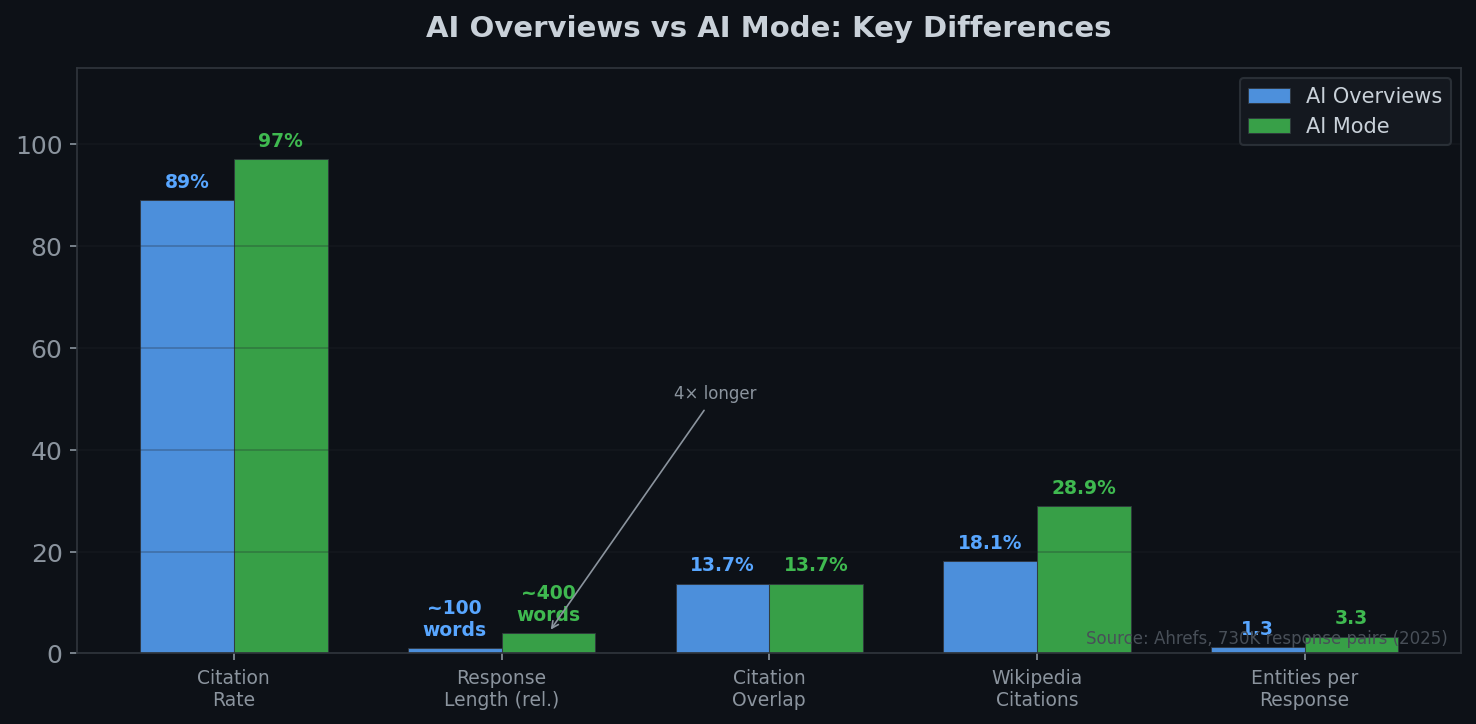
The strategic implications:
| Factor | AI Overviews | AI Mode | What to do |
|---|---|---|---|
| Citation rate | 89% | 97% | AI Mode nearly always links — build deep reference content |
| Response length | ~100 words | ~400 words | AI Mode rewards comprehensive pages |
| Wikipedia reliance | 18.1% | 28.9% | Get cited on Wikipedia or be the Wikipedia |
| Content overlap | — | Only 13.7% citation overlap | You can win in one and lose in the other |
| Brand queries | Prefers third-party sources | Favors brand-owned content | For AI Mode: own your narrative on your domain |
The key finding: only 13.7% of citations overlap between AI Overviews and AI Mode for the same query. They reach similar conclusions (86% semantic similarity) but cite fundamentally different sources. You need a strategy for each. [¹¹]
What Google officially says
Google’s guidance is refreshingly straightforward. From the official “AI Features and Your Website” documentation (last updated December 2025): [¹]
“The best practices for SEO remain relevant for AI features in Google Search. There are no additional requirements to appear in AI Overviews or AI Mode, nor other special optimizations necessary. “
Key points from the docs:
-
No special markup needed. “You don’t need to create new machine readable files, AI text files, or markup to appear in these features. There’s also no special schema.org structured data that you need to add.”
-
Indexing is the gate. Pages must be indexed and eligible for snippets — the same requirements as classic Search.
-
Control mechanisms exist. Use
nosnippet,data-nosnippet,max-snippet, ornoindexto limit how your content appears. For AI training/grounding specifically, useGoogle-Extendedin robots.txt. -
Search Console works. Performance data for both AI Overviews and AI Mode is reported under the “Web” search type.
-
Clicks are better. Google notes that clicks from AI Overviews tend to be higher quality — users spend more time on the destination site.
The Optimization Guide for generative AI (which Google links from the same documentation) reinforces: create helpful, reliable, people-first content — the same standard that applies to all of Google Search. [¹²]
One blind spot: Google only tells you about Google
Here’s what Google’s documentation doesn’t address: your AI visibility extends far beyond Google. ChatGPT, Perplexity, Claude, Gemini, Bing Copilot, and half a dozen other AI engines answer the same buying-intent questions your customers are asking — and each one cites different sources, with different behaviors.
Our own research across 11 AI engines found that Gemini cites zero sources in the majority of answers while mentioning brands up to 85% of the time. ChatGPT is a citation machine in some categories (70% in no-code) and nearly silent in others (0% for certain dev tools). The same content strategy that earns AI Overview citations can leave you invisible on ChatGPT — and vice versa. [¹³]
You can’t optimize for what you don’t measure.
RankBits tracks your brand’s visibility across 14 AI engines and search sources — not just Google AI Overviews and AI Mode, but ChatGPT, Perplexity, Claude, Gemini, Bing Copilot, and more. See exactly which engines cite you, which prompts you’re invisible on, and where your competitors are winning.
The bottom line
Google AI Overviews aren’t a separate channel to optimize for — they’re a new consumption layer on top of the same ranking fundamentals. The brands winning citations are the ones already winning organic rankings. The playbook hasn’t changed, but the stakes have: when 48% of queries show an AI answer and position 1 loses 58% of clicks, being the cited source is the new #1 position.
The five things to do this week:
- Audit your top 20 organic pages — check which ones earn AI Overview citations (Search Console → Performance → filter by query containing your target terms)
- Add answer-shaped sections to your 5 highest-traffic pages: clear H2 questions with 2–3 paragraph answers directly below
- Update publish dates on content from 2024 that still drives traffic but has gone stale
- Track your brand across engines — Google is only half the story; ChatGPT, Perplexity, and Claude are answering the same questions
- Monitor monthly — AI answers are non-deterministic; what’s cited today won’t necessarily be cited tomorrow
Sources
- AI Features and Your Website — Google Search Central (Updated Dec 2025)
- 16 Months of Tracking Google AI Overview Citations — Jim Yu / BrightEdge (Dec 2025)
- AI Overviews Reduce Clicks by 58% — Ahrefs (Dec 2025, 300K keywords)
- AIO Impact on Google CTR: 2026 Update — Seer Interactive (Feb 2026)
- Impact of Google’s AI Overviews: SEO Research Study — seoClarity (Sep 2025, 432K keywords)
- How to Optimise for Google AI Overviews — GAIN (Apr 2025)
- How to Get Featured in AI Overviews: 7 Top Strategies — SE Ranking (2025)
- Google AI Overviews: What’s Changing for SEO & SEA — Evergreen Media (Updated Feb 2026)
- 90+ AI SEO Statistics for 2025 — Ahrefs (2025)
- Google AI Overviews Ranking Factors — Wellows (2025)
- Are AI Mode and AI Overviews Just Different Versions of the Same Answer? — Ahrefs (730K responses)
- Optimizing for Generative AI Search — Google Search Central
- Which AI Coding Tool Does AI Recommend? — RankBits (Original research, Jul 2026)
- Google AI Overviews in 2026: 48% of Searches Have Them — theStacc (Apr 2026)
- Google AI Mode vs. Google AI Overviews — Evertune AI (2025)
Want to know what AI engines actually say when buyers search for your category? RankBits scans your brand across 14 engines — Google AI Overviews, AI Mode, ChatGPT, Perplexity, Claude, Gemini, and more — so you can fix the gaps competitors haven’t found yet. Run a free scan →