Two tools. Both under $200/month to start. Both purpose-built for AI visibility. But they solve fundamentally different problems.
ZipTie is built by technical SEO practitioners — the team behind agency Onely — and it shows. It’s the only tool in the category that tells you why you’re invisible and what to change, not just that you’re invisible. Otterly is the most accessible entry point in the market — Gartner Cool Vendor, 20,000+ users, clean UX, $29 to start — but it stops at monitoring.
This is an honest, data-backed comparison based on independent reviews, community feedback, and verified features.
At a Glance
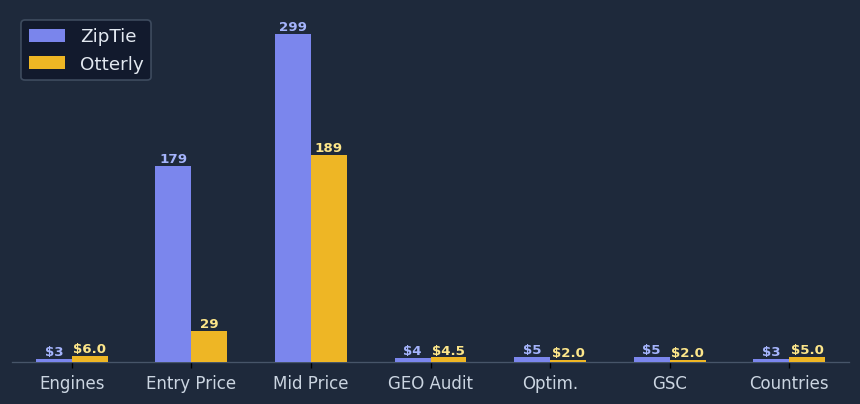
| ZipTie | Otterly | |
|---|---|---|
| Founded | 2024 (by Onely team) | 2023 |
| AI engines | 3 (Google AIO, ChatGPT, Perplexity) | 4 base + 2 add-ons (6 total) |
| Starting price | $179/mo (1,000 AI Search checks) | $29/mo (15 prompts) |
| Mid-tier | $299/mo (3,000 checks) | $189/mo (100 prompts) |
| Top tier | $799/mo (10,000 checks) | $489/mo (400 prompts) |
| Free trial | 14 days | 14 days |
| Claude tracking | No | No |
| GEO audit | No (content optimization instead) | Yes (25+ on-page factors) |
| Content optimization | Yes (actionable recommendations) | No |
| GSC integration | Yes | No |
| Best for | Technical SEO teams who want to fix visibility gaps | Small teams wanting affordable monitoring |
ZipTie: Deep Dive
What it does well
ZipTie was built by Tomasz Rudzki, Bartosz Góralewicz, and Sebastian Skowron — the team behind Onely, one of the most respected technical SEO agencies. That pedigree shows in everything the tool does. It is, as Frase’s comparison notes, “best for technical GEO audits” — the only tool in the category that combines monitoring with actionable optimization recommendations.
Browser-level accuracy, not API calls. ZipTie uses real-user-mimicking methods to capture what AI engines actually show, rather than relying on API approximations. This matters because API results can differ from what real users see in the browser. Geoptie’s review notes ZipTie “uses real-user-mimicking methods rather than pure API calls” — a technical differentiator that appeals to SEO practitioners who’ve been burned by inaccurate tracking.
AI Success Score is ZipTie’s proprietary composite metric that combines mention rate, citation share, sentiment, and position into a single number you can trend over time. Think of it as a “Domain Rating for AI search” — one number that tells you whether you’re improving or declining.
Content Optimization Recommendations are what separate ZipTie from pure monitoring tools. The platform doesn’t just tell you that you’re not appearing — it gives you page-specific briefs on what to fix. For teams that want to close the loop between detection and action, this is the killer feature.
Query Discovery Assistant pulls keywords from Google Search Console and generates AI-search queries from URLs — solving the “what should I track?” problem that paralyzes most teams starting with GEO.
Indexing Health Monitor audits whether LLM bots (GPTBot, PerplexityBot) can actually crawl and index your pages. This is crawler-level intelligence that most tools at this price point skip entirely.
The Reddit/SEO community genuinely respects ZipTie. ZipTie.dev’s own research notes that the platform “earns the top position because it addresses the category’s central pain point — the gap between knowing where you stand and knowing what to change.” That’s not marketing copy — it’s a consistent theme across independent reviews.
What it doesn’t do well
Only three engines. Google AI Overviews, ChatGPT, Perplexity. That’s the complete list. No Gemini. No Claude. No Copilot. No Grok. No AI Mode. For a tool that positions itself as technically sophisticated, the narrow engine coverage is a genuine limitation. If your buyers use Perplexity for research and Claude for analysis, ZipTie misses half the picture.
Credit-based pricing scales awkwardly. Each AI Search check counts against your monthly allowance. Track 50 prompts across 3 engines daily, and you’re consuming 150 checks per day — 4,500 per month. Even the Pro plan at $799/month (10,000 checks) can feel tight for agencies managing multiple clients.
No Gemini or Claude. At $179-$799/month, the absence of Gemini (25.5% web traffic share) and Claude (18.5% of B2B AI referrals) is hard to justify. The tool’s narrow focus makes sense if your primary concern is Google AI Overviews, but for full AI visibility, you’ll need another tool.
Pricing is higher than it first appears. Multiple sources cite different prices. The most current third-party data points to $179/month as the entry tier — significantly above Otterly’s $29. For teams just starting with AI visibility, the higher floor may be a barrier.
Otterly: Deep Dive
What it does well
Otterly is the most accessible AI visibility tool on the market. Period. At $29/month, you can start tracking your brand across four AI engines in under an hour. The G2 ratings speak for themselves: 4.9/5 across ~40 reviews, G2 Quality of Support at 9.7/10, Product Hunt 5.0/5. It was recognized as a Gartner Cool Vendor for AI in Marketing (2025) and a G2 High Performer in Winter 2026.
The GEO Audit is genuinely differentiated. Available from the Standard plan ($189/month), it analyzes 25+ on-page factors that affect how AI models interpret and cite your pages — schema usage, content length, multilingual structure, crawl issues — and converts them into urgency-ranked recommendations. AIPeekaboo’s review calls it “one of the more actionable features in the category.” Up to 5,000 URL audits per month on Standard, 10,000 on Premium.
Link citation tracking goes deeper than most tools. Otterly doesn’t just tell you your brand was mentioned — it shows which specific URLs AI engines are citing. If ChatGPT mentions your brand but links to a competitor’s comparison article instead of your site, that shows up. For content gap analysis, this is the feature that surfaces what to fix.
Six engines with add-ons. Base coverage includes ChatGPT, Google AI Overviews, Perplexity, and Copilot. Gemini and Google AI Mode are available as paid add-ons ($9-$149/month depending on tier). Six engines is broader than ZipTie’s three — though the add-on model means full coverage costs more than the headline price.
Semrush integration and Looker Studio. Otterly is available through the Semrush App Center, and its Looker Studio templates make client reporting straightforward. For agencies already in these ecosystems, the integration reduces friction.
50+ country coverage. If you operate globally, Otterly’s multi-country tracking is the strongest in the category at this price point. ZipTie doesn’t match this breadth.
20,000+ users and a 14-day free trial mean you can test with real data before committing.
What it doesn’t do well
Monitoring only. No action. This is the consistent criticism across every independent review. Otterly tells you whether you appear. It doesn’t tell you what to do about it. ZipTie.dev’s comparison captures it bluntly: “Tells you you’re losing, not why or what to do about it. Fine thermometer. Not a GPS.” A Reddit user on r/seogrowth put it similarly: “Good for alerts, useless for strategy.”
Prompt limits are punishing at the low end. The Lite plan at $29/month gives you 15 prompts. That’s not “monitoring” — that’s a one-time spot check. The jump to Standard at $189/month (100 prompts) is a 6.5x price increase. For serious tracking, you’re effectively starting at $189/month minimum.
Add-ons compound cost. Gemini and Google AI Mode are not in the base plans. They cost $9-$149/month extra. Analyze AI’s review notes: “The headline price of $189/month can realistically become $300+ before you have full engine coverage.”
No Claude. Despite Claude’s explosive growth as the fastest-growing AI assistant, Otterly doesn’t track it on any tier. For B2B brands where Claude drives 18.5% of AI referrals, this is a blind spot.
No content optimization. The GEO Audit diagnoses problems; it doesn’t prescribe solutions. You’ll need separate tools or internal expertise to act on what Otterly finds.
Manual prompt entry. In 2026, with AI prompt generation becoming standard, Otterly still requires you to manually enter every prompt you want to track. For teams monitoring dozens of queries across multiple product lines, this is tedious.
Output-focused only. Dageno AI’s review highlights a key limitation: “Otterly AI tracks what AI platforms show in their responses but cannot confirm whether AI crawlers actually visited your site.” ZipTie’s Indexing Health Monitor addresses this gap; Otterly doesn’t.
Head-to-Head: The Key Differences
Philosophy
ZipTie asks: “What do I need to change to get cited?” Otterly asks: “Am I being cited right now?” ZipTie is a diagnostic and optimization tool. Otterly is a monitoring and alerting tool. Your choice depends on whether you already know how to fix GEO problems or need a tool that guides you through it.
Engine coverage vs. optimization depth
Otterly covers more engines (6 vs 3). ZipTie goes deeper on the engines it covers (browser-level accuracy, indexing audits, content briefs). If you prioritize breadth, Otterly wins. If you prioritize depth and actionability, ZipTie wins.
Pricing at realistic usage
| Scenario | ZipTie | Otterly |
|---|---|---|
| Just getting started (minimal tracking) | $179/mo | $29/mo |
| Tracking 30 prompts across 3 engines | $179/mo (fits in 1,000 checks) | $189/mo (Standard, 100 prompts) |
| Tracking 100 prompts, all engines | $299/mo | $189/mo + add-ons (~$250-300) |
| Agency, 5 clients, heavy tracking | $799/mo | $489/mo Premium |
At the low end, Otterly is dramatically cheaper. At the mid-tier, the prices converge — but you get fundamentally different products. ZipTie gives you optimization guidance; Otterly gives you broader monitoring.
Who has the better GEO audit?
This depends on what you mean by “audit.” Otterly’s GEO Audit checks 25+ on-page factors across thousands of URLs and flags issues — schema gaps, crawl blocks, content structure problems. ZipTie’s approach is different: instead of a comprehensive audit, it gives you page-specific optimization briefs tied to specific prompts. Otterly tells you everything that’s wrong. ZipTie tells you what to fix for a specific query.
For a one-time comprehensive health check, Otterly’s GEO Audit is better. For ongoing optimization tied to specific visibility gaps, ZipTie’s approach wins.
Who Should Choose Which
Choose ZipTie if: - You’re a technical SEO practitioner who wants browser-level accuracy and optimization guidance - Google AI Overviews are your primary concern (ZipTie’s AIO tracking is best-in-class) - You want to close the loop between detection and action in one tool - You value the Onely team’s technical SEO credibility - You need GSC integration and indexing health monitoring
Choose Otterly if: - You’re a small team or solo marketer who needs affordable monitoring to start - You want the broadest engine coverage at this price point (6 engines) - You need multi-country tracking across 50+ countries - You value a clean UX and fast setup over optimization depth - You’re already a Semrush user and want AI visibility in your existing ecosystem - You want a comprehensive GEO audit of your entire site, not just specific queries
Choose neither if: - You need Claude, Grok, DeepSeek, or Meta AI tracking — neither covers them - You need full coverage including source layers (Google Search, Bing, Tavily, Exa) - You want a tool that combines broad coverage with optimization guidance at a simpler price point
A Simpler Alternative
ZipTie and Otterly represent two ends of a spectrum: deep technical optimization on 3 engines, or broad monitoring on 6 engines. Neither covers all the major AI chatbots. Neither tracks Claude — the fastest-growing AI assistant. Neither includes source-layer engines like Google Search or Bing that feed AI answers.
RankBits is built for teams that want complete coverage without complexity. You enter your domain, pick your prompts (or let the platform generate industry-relevant ones), and get a full visibility report across all 12 major AI engines — ChatGPT, Perplexity, Claude, Gemini, Copilot, DeepSeek, Google AI Overview, AI Mode, Google Search, Bing, Tavily, and Exa — in minutes.
No per-engine add-ons. No credit math. No manual prompt entry required. Just a complete picture of where your brand stands across every AI surface that matters.
Sources
- ZipTie.dev — “Best Multi-Model AI Search Visibility Monitoring Tools in 2026” (2026)
- ZipTie.dev — “Best AI Search Tracking Software for Agencies in 2026” (2026)
- Rankability — “ZipTie AI Review 2026: Is It Worth the Investment?” (2026)
- Denebrix AI — “What Is ZipTie AI Search Analytics? (2026 Full Guide)” (2026)
- Geoptie — “10 Best AI Search Visibility Tools in 2026” (2026)
- Geoptie — “7 Best ZipTie Alternatives for 2026” (2026)
- Mentionable — “AI Search Visibility Tools 2026” (2026)
- Frase — “The 10 Best AI Visibility Tools in 2026 (Compared)” (June 2026)
- Trakkr — “Otterly AI Pricing 2026: Plans, Add-Ons & a $100 Option” (June 2026)
- AIPeekaboo — “Otterly AI Review (2026): Pricing, Features, and Is It Worth It?” (May 2026)
- Analyze AI — “Otterly AI Review 2026: Tracking Your First 100 Prompts” (2026)
- Dageno AI — “Otterly AI Review 2026: Is It Worth the Investment?” (2026)
- Trustmary — “Best AI Search Visibility Tools for Businesses in 2026” (2026)
- Scalenut — “Otterly AI Review: Should Content Teams Use It In 2026?” (2026)
- SmallPPT — “What Is Ziptie AI Search Analytics? Features, Pricing & Top 5 Alternatives” (2026)