Most SEO work targets Google, which handles about 91% of searches. But AI assistants don’t all search Google. ChatGPT’s search uses partners including Microsoft, Copilot runs on Bing, and DuckDuckGo gets most of its results from Bing. So we checked how different the two engines’ results are, and which AI engines follow which.
We compared Google and Bing results for 1,765 buyer questions asked in the same RankBits scans:
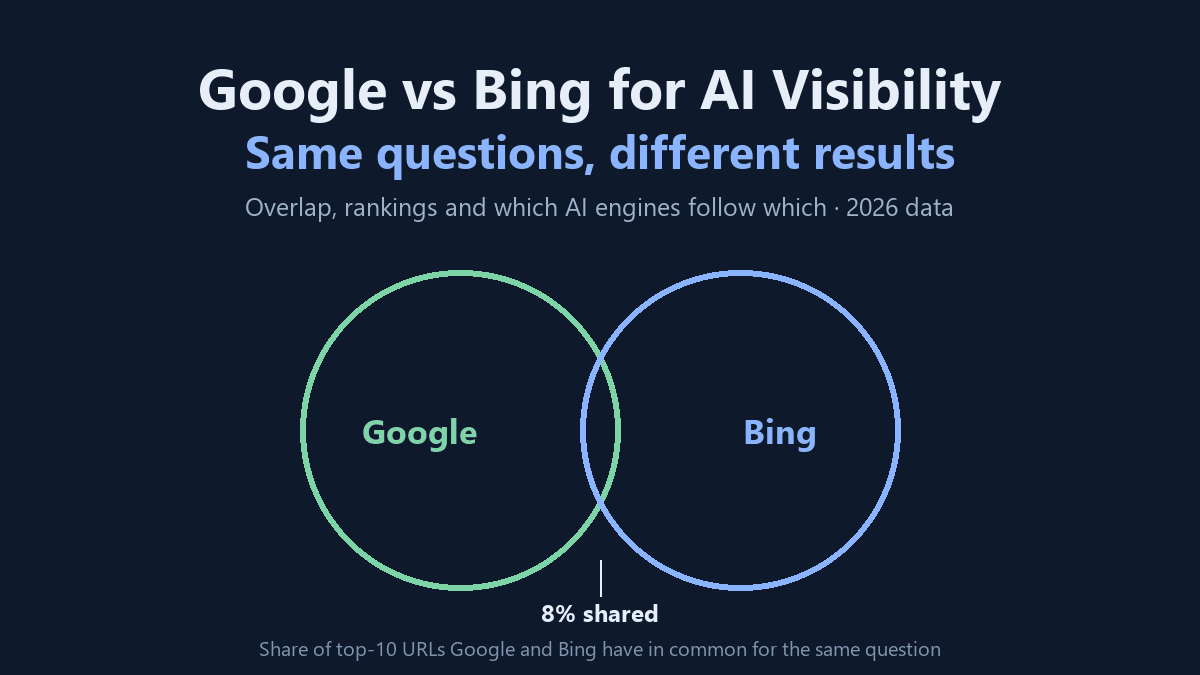
- They barely overlap. For the same question, the two top 10s share only 8% of URLs and 12% of domains.
- Ranking on one doesn’t mean ranking on the other. A brand in Google’s top 10 was also in Bing’s top 10 only 63% of the time.
- Different AI engines follow different search engines. Copilot tracks Bing; Gemini, Claude and AI Overviews track Google; ChatGPT follows both about equally.
- Bing finds new pages much faster when you use IndexNow. It crawled our new posts within minutes; Google took about two days and still doesn’t rank them.
How we compared them
Method and limits
- RankBits scans, 19 June – 9 November 2026: Google results for 2,205 prompts (233 brands), Bing for 1,791 (144 brands), and 1,765 prompts with both. DuckDuckGo and Yahoo: about 470 prompts each (13 brands).
- Prompts are natural-language buyer questions that don't name the brand, not short keywords. Overlap between engines is probably higher for short keyword searches.
- Google results go 100 deep; Bing, DuckDuckGo and Yahoo 50 deep. Comparisons use the top 10 unless stated.
- "Ranks" means the brand's own site appears in the results. The largest single brand is 16% of the Bing sample; most brands are software companies.
- Crawl timings come from our own rankbits.com server logs: one site, so treat them as a case study.
- All figures are aggregated and anonymised.
1. Google and Bing show different pages
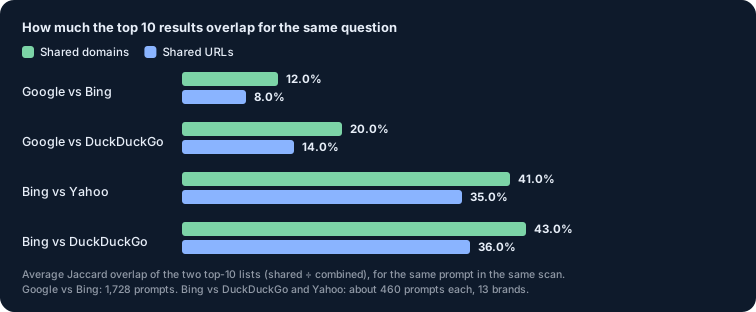
- Google vs Bing: only 14% of Google’s top-10 URLs appear anywhere in Bing’s top 10, and 21% in Bing’s top 50.
- DuckDuckGo and Yahoo follow Bing. Their top 10s share 35–36% of URLs with Bing’s. When a brand was in Bing’s top 10, it was in DuckDuckGo’s 91% of the time and Yahoo’s 85% of the time. That fits DuckDuckGo’s statement that it “largely” sources results from Bing, and Yahoo’s long-standing Bing deal.
- Rank order differs too. When a brand ranked on both Google and Bing, it held the same position only 28% of the time (rank correlation 0.50). For Bing against DuckDuckGo and Yahoo, the correlation was 0.84–0.88.
2. Ranking on one doesn't mean ranking on the other
On the 1,765 questions asked to both:
| Brand's site in the top 10… | Share of questions |
|---|---|
| On both Google and Bing | 20.8% |
| On Google only | 12.2% |
| On Bing only | 6.5% |
| On neither | 60.5% |
- A Google top-10 brand was in Bing’s top 10 63% of the time. Going the other way, a Bing top-10 brand was in Google’s top 10 76% of the time.
- “Alternatives to X” questions were the hardest on both: only 12% of brands made the top 10.
3. They favour different kinds of pages
| Share of top-10 results | Bing | |
|---|---|---|
| 5.9% | 0.5% | |
| YouTube | 2.8% | 0.2% |
| Quora | 1.3% | 0% |
| GitHub | 0.4% | 1.0% |
| Homepages | 8.0% | 11.1% |
| "Best X" and comparison pages | 13.3% | 15.5% |
| Blog posts and articles | 19.4% | 15.1% |
| Brands' own sites | 3.7% | 3.8% |
| Different domains in a top 10 | 9.2 | 8.4 |
| Most results from one domain | 1.2 | 1.6 |
- Google leans on communities: Reddit, YouTube and Quora together take about 10% of its top 10, against under 1% on Bing.
- Bing favours homepages and “best X” pages, and it more often shows several results from the same site. A site with several strong pages can take up more of Bing’s first page.
4. Which AI engines follow which search engine
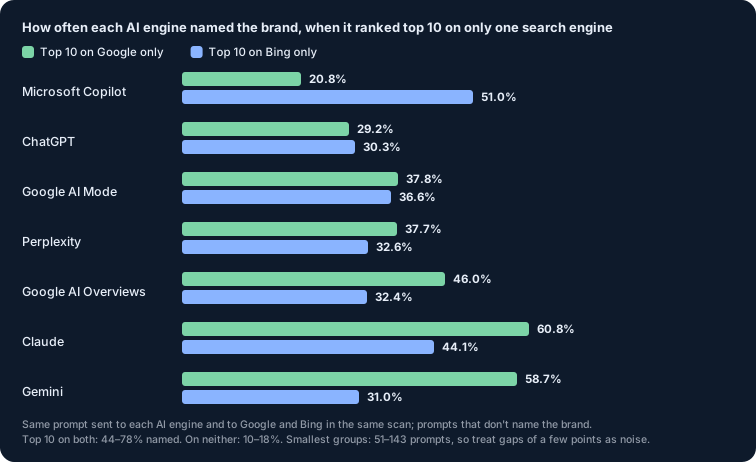
- Copilot follows Bing. Brands that ranked top 10 only on Bing were named 51% of the time, against 21% for Google-only brands. Copilot is Microsoft’s.
- Gemini, Claude and Google AI Overviews follow Google, by 14–28 percentage points.
- ChatGPT follows both about equally, at 29–30%. OpenAI says its search uses partners, and its help page points to Microsoft’s privacy statement.
- AI Mode and Perplexity sit in between.
- Ranking on both is best everywhere: brands in both top 10s were named 44–78% of the time, against 10–18% for brands in neither.
5. Bing found our new posts within minutes; Google took days
We published seven posts in the past week and pinged IndexNow each time. From our server logs:
- Bingbot fetched posts within minutes of the IndexNow ping, for example 3 minutes after publishing today’s post. It fetched four of the seven.
- Googlebot fetched only 2 of the 7, about two days after publishing. Google doesn’t use IndexNow.
- Bingbot requested blog pages more than twice as often as Googlebot: 193 against 89 in the past two weeks.
- Six days after publishing, two of our five 3-November posts ranked #1 on Bing for their titles. Google showed none of the five in its top 100.
What to do
- Set up both consoles. Verify your site in Google Search Console and Bing Webmaster Tools, and submit your sitemap to each.
- Use IndexNow. Bing, Naver, Seznam, Yandex and Yep support it. Bing usually crawls a pinged URL within minutes, and Bing feeds DuckDuckGo, Yahoo, Copilot and part of ChatGPT’s search.
- Check your rankings on both engines, for the questions your buyers ask AI. With only 8% overlap, a strong Google position tells you little about Bing.
- Match your effort to the AI engines your buyers use. For Copilot and ChatGPT, Bing rankings count. For Gemini, AI Overviews and Claude, Google rankings count more.
- Content for Google: answer questions in articles, and be present where Google pulls community answers: Reddit, YouTube and Quora.
- Content for Bing: a clear homepage, strong “best X” and comparison pages, and several solid pages on the same topic, since Bing often shows more than one result per site.
- Don’t track DuckDuckGo and Yahoo separately at first. They mostly follow Bing, so fixing Bing fixes most of them.
See where you rank on Google, Bing, DuckDuckGo and Yahoo for each buyer question, next to what ChatGPT, Copilot, Gemini and other AI engines answer. Start with the free AI visibility checker or see plans.
Sources
- Search market share: StatCounter, search engine market share (October 2026: Google about 91%, Bing about 5%).
- ChatGPT search partners: OpenAI Help Center, Searching the web with ChatGPT (query rewriting for search partners; links to Microsoft’s privacy statement).
- DuckDuckGo results: DuckDuckGo help, Where do your results come from? (“largely” from Bing, plus its own crawler).
- Yahoo and Bing: InfoWorld, Microsoft and Yahoo sign search deal (2009).
- IndexNow: indexnow.org (supported by Microsoft Bing, Naver, Seznam.cz, Yandex and Yep).
- RankBits data: Google and Bing results for 1,765 shared prompts, plus DuckDuckGo and Yahoo samples, June–November 2026 (aggregated and anonymised); rankbits.com server logs 26 October – 9 November 2026; title searches on 9 November 2026.
- Related: How to Rank on Tavily and Exa · Which AI Engine Is Hardest to Get Recommended By?