We build RankBits, so treat the framing here with the scepticism it deserves — and then check the numbers, because the numbers are the only part of a vendor comparison worth anything. Every price in this article is linked to its source with the date we checked it. Where sources disagree, we say so instead of picking the figure that suits us.
The reason this comparison is interesting is a coincidence: the standalone Semrush AI Visibility Toolkit and RankBits Pro both cost $99 per month. Identical sticker price. But the two products slice that $99 along completely different axes. Semrush sells you one domain, with your own prompts tracked across three AI engines. RankBits sells you unlimited brands across eighteen engines, metered by response volume instead of by domain.
That difference doesn’t matter much if you track one brand. It matters enormously if you track ten, which is the normal condition for an agency or a consultant. So this article is mostly arithmetic.
Why you will see different engine counts elsewhere — and why we say three. Published counts for the Semrush toolkit range from two to five, and the reason is that Semrush's engine coverage differs by feature, not by tier. Two numbers are both true:
- Prompt Tracking — 3 platforms. Semrush's documentation states this feature tracks "ChatGPT Search, Google AI Mode, and Gemini." This is the feature that does the same job as RankBits: you supply your own prompts and get daily positions. It is the apples-to-apples number, so it is the one we use.
- Brand Performance — 5 surfaces. Google AI Overviews, AI Mode, ChatGPT, Perplexity and Gemini. Broader, but it is aggregate brand monitoring rather than your own tracked prompts, and it refreshes weekly rather than daily.
So Perplexity is covered by the toolkit — in Brand Performance, not in Prompt Tracking. Claude, Microsoft Copilot, Grok and DeepSeek are not in the $99 toolkit at all; they require the separate Enterprise AIO product. Semrush's pricing page markets four named AI surfaces, which is where much of the published confusion comes from. Prices also render dynamically and vary by region and promotion. If a number below disagrees with the live page, the live page wins — not us.
Side by side, at a glance
| Semrush AI Visibility Toolkit | RankBits | |
|---|---|---|
| Entry price | $99/mo. No free tier, and no trial of the standalone toolkit | $0/mo Free tier, forever |
| Comparable paid tier | $99/mo per domain | $49/mo Starter · $99/mo Pro |
| Priced per… | Per domain. Each extra domain slot is another $99/mo | Per account. Pro includes unlimited brands |
| Extra users | AI Visibility access is $99/mo per additional user, on top of the extra account seat itself (from $45/mo) | No separate per-seat AI Visibility licence (seat limits do apply — see limitations) |
| AI engines, your own prompts | 3 — ChatGPT Search, Google AI Mode, Gemini | 5 on Free · 13 on Starter · 18 on Pro, including paid-model variants |
| AI surfaces, brand monitoring | 5 — adds Google AI Overviews and Perplexity, refreshed weekly | Same 18 engines, no separate feature tier |
| Claude / Copilot / Grok | Not in the $99 toolkit — requires the separate Enterprise AIO product | Claude, Claude Paid, Bing Copilot, Grok 4.7 and SuperGrok 4.7 on Pro |
| Prompts tracked | 25, tracked daily. Extra 50-prompt packs are +$60/mo. Semrush One bundles raise this to 50 / 100 / 200+ | 5 Free · 20 Starter · 50 per scan on Pro |
| Response volume | Not published as a response/credit figure | 100/mo Free · 2,400/mo Starter · 5,000/mo Pro · $0.030 per extra credit, credits never expire |
| Tracking cadence | Prompt Tracking refreshes daily; Brand Performance weekly | Weekly on Free and Starter · daily on Pro |
| Locations | Strong but tiered: 220+ countries and territories in the underlying SEO databases, roughly 40–45 countries for AI brand reports, and prompt Volumes & Topics analytics in 15 named countries | Far fewer; country/language targeting is not a 220-location matrix |
| API access | No public API entitlement is documented for the AI Visibility Toolkit. "Advanced API data integration" appears on the custom-priced Advanced plan | Included on every plan, including Free, after email verification |
| Exports & client reports | Mature agency reporting stack and BI connectors; white-label Pro Reports are billed separately at $20 per report per month | Exports plus public shareable report links on Free and Pro |
| Annual discount | None on the standalone toolkit — $99 under both billing toggles. The SEO and Semrush One plans do discount annually (up to ~17%) | See the live pricing page |
| Best fit | In-house teams already paying for Semrush SEO who want AI visibility inside one platform, with deep SEO data and fine-grained geography | Agencies, consultants and lean teams tracking several brands across many AI engines on a fixed budget |
What $99 buys on each side
Three measures, same price point. Each row below is scaled to its own maximum, because brands, engines and dollars are not the same unit.
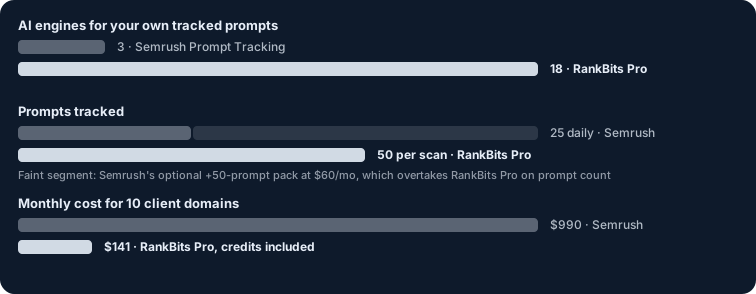
The shape of the trade is already visible. Semrush charges for scope — one domain at a time. RankBits charges for volume — how many AI answers you pull per month — and lets you spread that volume across as many brands and engines as you like.
Which model is cheaper depends entirely on your shape. One brand, deep geography, already on Semrush? The per-domain model is fine. Ten brands? It is not.
Engine coverage: 3 vs 18, and why it matters more than it sounds
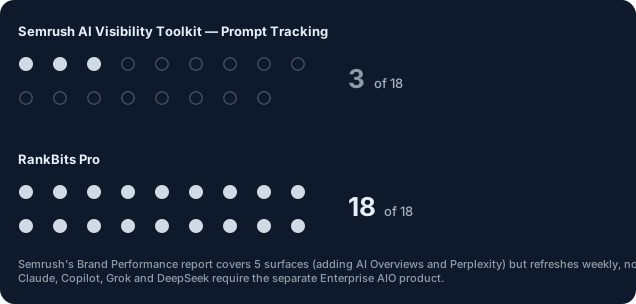
The 18 engines RankBits Pro tracks
Free (5): ChatGPT, Google AI Overview, Google Search, Bing Search, Perplexity.
Starter adds 8 (13 total): Google AI Mode, Gemini, DuckDuckGo Search, Yahoo Search, Grok 4.7, Claude, Tavily, Exa.
Pro adds 5 (18 total): ChatGPT Paid, Gemini Paid, SuperGrok 4.7, Claude Paid, Bing Copilot.
Note the paid variants. ChatGPT Paid, Gemini Paid, Claude Paid and SuperGrok 4.7 often return different answers — and different citations — than their free counterparts, because they run different models with different retrieval behaviour. If your buyers are B2B decision-makers, they are disproportionately on paid tiers.
Engine breadth is usually sold as a feature-count brag. It isn’t. It is a measurement-quality problem.
AI answers are non-deterministic. Ask the same question twice and you can get two different brand lists. We’ve written about this at length in how we handle prompt research and in what an AI visibility score actually measures, but the short version: a single observation from a single engine is close to noise. Confidence comes from sampling — more prompts, more engines, more runs.
So a three-engine tracker has two structural problems:
- Blind spots. Prompt Tracking covers ChatGPT Search, Google AI Mode and Gemini. That leaves your own prompts unmeasured on Claude, Microsoft Copilot, Grok and DeepSeek entirely — those need Enterprise AIO — and unmeasured day-to-day on Perplexity, which appears in the weekly Brand Performance report but not in daily prompt tracking. That isn’t a smaller picture, it’s a picture with holes you can’t see the edges of. You will not know your prompt-level position on Claude until a client asks.
- Noisier aggregate. Three engines give you a thin sample, and two of the three are Google properties, so they are correlated — when Google changes something, two-thirds of your sample moves together. When that happens your headline metric wobbles with it, and you spend client calls explaining variance instead of strategy.
To be fair to Semrush: breadth is not free, and more engines means more API cost, more maintenance and more surface area for things to break. A narrow, well-instrumented three-engine product is a defensible choice, particularly if ChatGPT and Google genuinely dominate your category’s referral traffic. For a lot of consumer brands, they do. Semrush also backs its analysis with a prompt database it describes as over 317 million prompts and responses — depth of a kind we have no equivalent for.
But narrowness should be cheap, and here it isn’t — it costs the same $99 as eighteen engines elsewhere.
Pricing that scales with clients, not seats
This is the section that decides the comparison for agencies, so let’s be explicit about the arithmetic and show the unflattering parts too.
The Semrush side is simple multiplication. The AI Visibility Toolkit is priced per domain at $99/month, identical on monthly and annual billing — the annual discount that applies to the SEO and Semrush One plans does not apply to the toolkit:
- 1 client domain → 1 × $99 = $99/mo ($1,188/yr)
- 5 client domains → 5 × $99 = $495/mo ($5,940/yr)
- 10 client domains → 10 × $99 = $990/mo ($11,880/yr)
- 25 client domains → 25 × $99 = $2,475/mo ($29,700/yr)
Then the add-ons stack on top:
- Need more than the 25 included prompts? +$60/mo per extra 50-prompt pack, per domain. Ten domains that each need an extra pack is 10 × ($99 + $60) = $1,590/mo.
- Need a second person to see the data? AI Visibility access is $99/mo per additional user, charged on top of the extra account seat itself (seats start at $45/mo). A five-client agency with three people looking at AI data is 5 × $99 + 2 × $99 = $693/mo before the seat fees.
- Want white-label client reports? Pro Reports are billed at $20 per report per month, separately from the toolkit.
- Want to try before you commit? There is no free trial of the standalone toolkit, so the first look costs $99. The seven-day trial Semrush advertises covers Semrush One, which starts at $199/mo.
The RankBits side is not free, and we’re not going to pretend it is. Pro is $99/month for unlimited brands, 50 prompts per scan, 18 engines and 5,000 responses per month. The brand count is unlimited; the response count is not, and the response count is what actually binds.
A response is one prompt sent to one engine on one run. So:
responses/month = brands × prompts × engines × runs per month
That one formula governs everything. Weekly tracking is ~4 runs/month; daily is ~30.
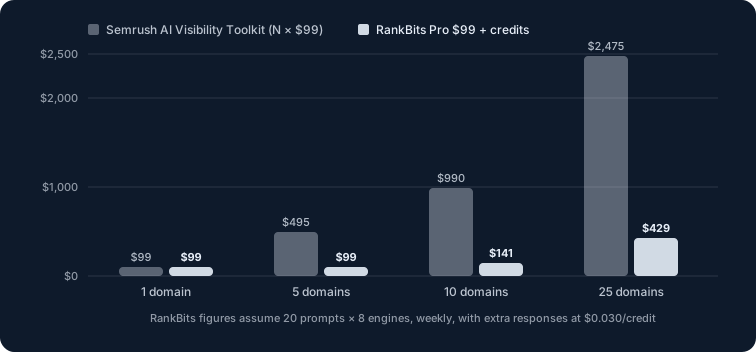
Full arithmetic behind the chart
Configuration: 20 prompts per brand, 8 engines, weekly tracking (4 runs/month). That's 20 × 8 × 4 = 640 responses per brand per month. Pro includes 5,000; extras cost $0.030 each.
- 1 brand: 640 responses. Under the allowance. $99/mo.
- 5 brands: 3,200 responses. Under the allowance. $99/mo.
- 10 brands: 6,400 responses. 1,400 over × $0.030 = $42. $141/mo.
- 25 brands: 16,000 responses. 11,000 over × $0.030 = $330. $429/mo.
- 30 brands: 19,200 responses. 14,200 over × $0.030 = $426. $525/mo versus 30 × $99 = $2,970/mo.
Credits are sold at 1,000 for $30, and RankBits states that "each extra 1,000 credits is 8% cheaper than the last," so the real top-up cost at the higher volumes above is lower than shown. We have used the undiscounted $0.030 rate throughout so the numbers are conservative against us in the only direction that matters — they are the worst case for RankBits.
Now the honest counterweight. Turn every dial to maximum and RankBits is not cheap. Ten brands at the full 50 prompts across all 18 engines, weekly, is 10 × 50 × 18 × 4 = 36,000 responses/month. That’s 31,000 over the allowance, or $930 in credits, for $1,029/mo — slightly more than the $990 Semrush would charge for ten domains.
You are getting six times the engine coverage for that money, which we’d argue is the better deal. But the claim “RankBits is always cheaper” is false, and we’re not making it. The accurate claim is narrower: RankBits is dramatically cheaper at realistic configurations, and its cost scales with how much measurement you actually consume rather than with how many logos are on your client list.
The dial that saves the most money is engine count, not prompt count. Responses scale multiplicatively, so halving your engine list halves your bill just as effectively as halving your prompts. Most agencies get a better signal-to-cost ratio from 20 prompts × 10 engines than from 50 prompts × 4 engines, because prompt variance within a topic is usually smaller than variance between engines. Our GEO checklist covers how to choose which prompts earn their place.
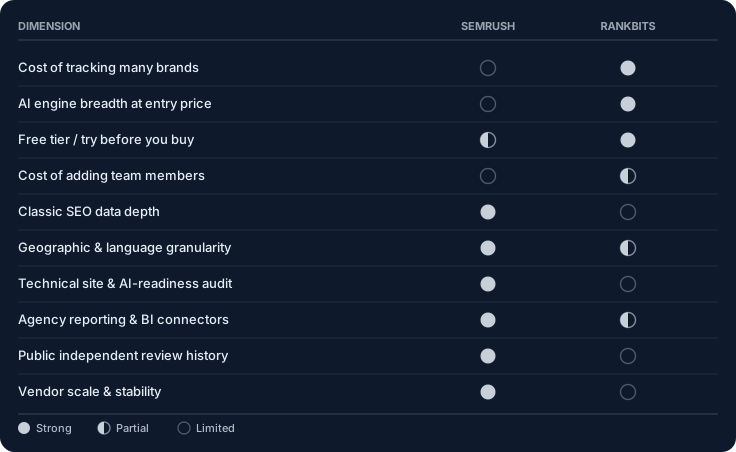
Where Semrush genuinely wins
If you only read one section to calibrate how much to trust the rest, read this one.
Classic SEO data depth. This is not close. Semrush has spent well over a decade building keyword databases, backlink indexes, rank-tracking history and competitive datasets. RankBits has none of that and isn’t trying to. If your AI visibility work needs to connect to keyword volumes, SERP history, competitor backlink gaps or share-of-voice across organic search, Semrush has the data and we don’t.
Geographic and language granularity. This is a real differentiator, and it is worth stating precisely rather than repeating the headline number. Semrush’s underlying SEO databases span 117 regional databases across 220+ countries and territories; AI brand reporting covers roughly 40–45 countries; and the richest prompt analytics — Volumes and Topics — are available in 15 named countries (Australia, Brazil, Canada, France, Germany, India, Italy, Japan, Mexico, Netherlands, Spain, Sweden, UAE, UK, US). So “220+” is the SEO figure, not the AI-visibility figure. Even at 40–45 countries, though, Semrush is far ahead of us: if you need to know how you appear in AI answers in Germany versus Austria versus Switzerland, in German, buy Semrush. RankBits is not competitive here.
Daily refresh at the entry price. Cadence is not a RankBits advantage, and it is often misreported as one. Semrush’s Prompt Tracking refreshes your 25 prompts daily on the $99 standalone toolkit; RankBits does daily only on Pro, also $99. That is a tie on paper — and in practice Semrush’s daily refresh comes with no response budget to manage, whereas ours does.
Site Audit and AI Search Health. Semrush connects visibility measurement to technical diagnosis — crawlability, structured data, the on-site conditions that determine whether AI crawlers can read and cite you at all. RankBits tells you whether you’re being cited; it doesn’t crawl your site to tell you why not. For a lot of teams, that diagnostic half is the actionable half.
Real-user panels versus API sampling. Semrush has access to clickstream and panel data, which measures what people actually encountered. API-based tools — RankBits included — simulate queries by sending prompts to engines. API sampling is cheaper, more controllable and more reproducible, but it is a model of user behaviour, not an observation of it. Those are different epistemics and panel data is genuinely stronger evidence for “what did real users see.”
The agency reporting stack. White-label reports, scheduled client deliverables, BI connectors, an established integrations ecosystem. If your agency’s reporting workflow already runs through Semrush, pulling AI visibility into that same pipeline has real operational value that a cheaper standalone tool does not replicate. RankBits has exports and public report links; it does not have a reporting platform.
Vendor stability. Adobe completed its acquisition of Semrush Holdings on 28 April 2026 — a $1.9 billion all-cash deal at $12 per share, announced on 19 November 2025 and closed ahead of its original first-half-2026 target. Adobe has said it plans to integrate Semrush’s technology with Adobe Experience Manager, Adobe Commerce and Adobe Experience Platform. Read that how you like — it can cut both ways, and acquisitions do sometimes mean roadmap churn or repricing. But a product owned by Adobe is not going to vanish because a founder loses interest. RankBits is bootstrapped and small, and that is a real risk you are taking on. Procurement teams are right to weigh this.
Review track record. Semrush has years of public, independent reviews across the major software marketplaces. You can research it properly before buying. You cannot do that with RankBits yet.
Where RankBits genuinely wins
- Price per brand tracked. $99/mo for unlimited brands versus $99/mo per domain. At ten clients that’s $141/mo against $990/mo in a realistic configuration — roughly $10,188 a year of difference.
- Engine breadth. 18 engines on Pro against 3 in Semrush’s Prompt Tracking. The ones you cannot get from the $99 Semrush toolkit at all are Claude, Bing Copilot and Grok, which require Enterprise AIO — plus Perplexity at daily prompt-level cadence, since Semrush covers Perplexity only in its weekly Brand Performance report. Gemini is covered by both, so don’t let anyone tell you otherwise.
- Paid-model variants. ChatGPT Paid, Gemini Paid, Claude Paid and SuperGrok 4.7 are tracked separately. Paid tiers answer differently, and for B2B that’s where your buyers are.
- A real free tier, forever. $0 for 1 brand, 5 prompts, 5 engines, weekly, 100 responses/month, with public shareable reports. There is no trial of the standalone Semrush toolkit — its seven-day trial is for Semrush One, which starts at $199/mo — so the cheapest way to see whether AI visibility tracking is useful to you is $0 on one side and $99 on the other. You can also run a one-off check with no account via the free AI visibility checker.
- API access on every plan, including Free. After email verification. This is unusual — most tools in this category gate the API behind the top tier, and Semrush documents no public API entitlement for the AI Visibility Toolkit at all; “Advanced API data integration” appears only on the custom-priced Advanced plan. If you want AI visibility data in your own warehouse or client dashboards, this is the difference between possible and not.
- No per-seat AI Visibility tax. You don’t buy a second $99 licence so a colleague can look at the data.
- Public shareable client reports. A link you send a client, no login, no seat. For agencies this quietly removes the main reason you’d otherwise need to buy seats.
- Credits that don’t expire. Unused top-up credits roll forward, which matters if your scanning is lumpy around campaign launches.
If you want to see how this stacks up against the other specialists rather than against Semrush, we’ve run the same exercise for Peec AI and Profound, and surveyed the wider field in Semrush AI Toolkit alternatives and the best ChatGPT rank trackers for 2026.
Honest limitations of RankBits
RankBits is not enterprise-ready, and we'd rather say that here than have you discover it during a procurement review.
- New and bootstrapped. Small team, no outside funding, no enterprise support organisation, no SLA you could wave at a CFO. If your business requires vendor-risk sign-off, we will probably fail it, and Semrush will probably pass.
- No G2 presence and no independent review history. You cannot validate our claims against a body of third-party reviews, because that body doesn’t exist yet. Everything in this article is checkable against pricing pages; nothing in it is checkable against other customers’ experiences. That is a legitimate reason to be cautious.
- The response cap is the real ceiling. “Unlimited brands” is true and also easy to over-read. At full breadth — 50 prompts × 18 engines — one brand consumes 900 responses per scan, so Pro’s 5,000 responses cover about five and a half full-breadth scans per month for a single brand. Daily tracking at 18 engines on one brand means roughly 9 prompts, not 50. The dials trade against each other and you should plan them deliberately.
- Starter’s caps don’t line up neatly. Starter allows 3 brands and 13 engines, but its 2,400-response allowance can’t sustain all three at once: 3 brands × 20 prompts × 13 engines × 4 weekly runs is 3,120 responses. Three brands weekly actually fits at about 10 engines, not 13. You can buy credits to close the gap, but the headline numbers imply more room than the allowance gives.
- Smaller prompt caps than the top of the market. 50 prompts per scan on Pro is enough for focused measurement, not for broad topical coverage of a large catalogue.
- No native Looker Studio connector. You get exports and an API; you don’t get a drop-in BI connector. If your client reporting runs on Looker Studio, that’s glue code you have to write.
- Not unlimited seats. Brands are unlimited; users are not. Public shareable reports cover most of the need, but if you want twenty logins, check the plan limits first.
- API sampling, not panel data. As above — we model queries rather than observe real users. We think that’s the right trade at this price, but it’s a trade.
Who should buy which
| Buy Semrush AI Visibility Toolkit if… | Buy RankBits if… |
|---|---|
| You already pay for Semrush SEO and want AI data in the same platform | You track more than two or three brands and the per-domain fee is the binding constraint |
| You track one or two domains and need deep geographic and language breakdowns | You need Claude, Copilot or Grok coverage, or daily prompt-level data on Perplexity — none of which the $99 Semrush toolkit provides |
| You need technical site auditing and AI-readiness diagnosis alongside measurement | You want to validate the category at $0 before committing budget |
| You need panel/clickstream evidence of what real users saw | You want the data in your own dashboard via API, on any plan |
| Procurement requires an established vendor with a public review history | You share results with clients via links instead of buying seats |
| Your reporting pipeline is already built on Semrush's connectors | Your budget is fixed and you'd rather spend the difference on content |
Solo consultant, 1–2 clients
Semrush: $99–$198/mo for 25 daily prompts on three engines. RankBits Free covers one brand at 5 prompts across 5 engines, weekly — enough to decide whether you care. Pro at $99/mo runs one brand at the full 50 prompts × 18 engines weekly for 3,600 responses, comfortably inside the allowance. Verdict: start on Free. At one domain the prices and the daily cadence are identical, so the deciding factor is breadth — 18 engines against 3.
Five-client boutique agency
Semrush: 5 × $99 = $495/mo ($5,940/yr), with 25 daily prompts per domain on three engines, plus another $99 for each colleague who needs access. RankBits Pro: 5 brands × 25 prompts × 10 engines × 4 weekly runs = exactly 5,000 responses, which lands precisely on the included allowance. $99/mo, $1,188/yr — a difference of $4,752 a year, with more than three times the engine coverage. The honest trade is cadence: that configuration is weekly, where Semrush would give you daily. If you want daily on five brands you’ll need to cut engines or buy credits. Verdict: RankBits, but configure it deliberately.
Thirty-client agency
Semrush: 30 × $99 = $2,970/mo ($35,640/yr) before prompt add-ons or extra seats. RankBits Pro at 20 prompts × 8 engines weekly: 19,200 responses, 14,200 over the allowance, $426 in credits, $525/mo ($6,300/yr) — and less than that with volume discounts. A difference of about $29,340 a year. Verdict: RankBits on cost, with the honest caveat that a thirty-client agency is also the buyer most likely to need the white-label reporting and vendor assurances we don’t have. Some agencies will rationally pay the $29,000 for the reporting stack and the Adobe logo. Most won’t.
Bottom line
The $99-versus-$99 symmetry is a coincidence that hides the actual decision. Semrush’s $99 buys depth on one domain — deep SEO data, a 317-million-prompt database, AI reporting across 40-odd countries, technical diagnosis, panel evidence, a mature reporting stack, daily refresh, and a vendor now owned by Adobe. RankBits’ $99 buys breadth across all your domains — 18 engines, unlimited brands, API on every plan, shareable client reports, and daily tracking if your response budget allows it.
If you track one brand and need geography or site diagnosis, Semrush is the better product and we’d tell you to buy it. If you track several brands across many AI engines on a fixed budget — which describes most agencies and most lean in-house teams — the arithmetic is not close: $141/mo against $990/mo at ten clients, with six times the engine coverage.
What we will not claim is that RankBits wins on everything. It is new, bootstrapped, unreviewed, and its response cap is a real ceiling that the phrase “unlimited brands” can disguise. Run the formula — brands × prompts × engines × runs — against your own client list before you believe any of this. And check our numbers against the live pricing pages, because that is the whole point of writing them down.
Check how your brand appears across 18 AI engines right now with the free AI visibility checker — no account needed — or start on the free plan and track one brand weekly for $0, forever.
Sources
Everything below was checked on 2 November 2026. Both vendors change prices; the live pages are authoritative over this article.
Primary sources — Semrush’s own pages
- Prompt Tracking covers “ChatGPT Search, Google AI Mode, and Gemini”; 25 prompts on the AI Visibility Toolkit, 50 on Semrush One Starter, 100 on Pro+, 200 on Advanced; daily position updates; Volumes and Topics available in 15 named countries — Prompt Tracking on Semrush (checked 2 November 2026). This is the source for our headline “3 engines” figure.
- Brand Performance tracks “Google AI Overviews, AI Mode, ChatGPT, Perplexity, and Gemini” — Semrush Features for AI Visibility (checked 2 November 2026). This is the source for the “5 surfaces” figure.
- Semrush One includes the SEO and AI Visibility toolkits, is sold in Starter, Pro+ and Advanced plans, and carries a seven-day free trial — What is Semrush One? (checked 2 November 2026).
- AI prompt database described as “over 317 million prompts and responses” — Where does the data in Semrush’s AI Visibility Toolkit come from? (checked 2 November 2026).
- Plan pricing: SEO $139/mo ($117.33 annual), Starter $199/mo ($165.17 annual), Pro+ $299/mo ($248.17 annual), Advanced custom; additional users “Starting at $45/mo”; “Advanced API data integration” on Advanced; up to 17% annual saving; seven-day trial — semrush.com/pricing/seo-ai-search and semrush.com/pricing (both checked 2 November 2026). These pages render dynamically and vary by region and promotion.
Independent audits — used for the standalone toolkit’s add-on pricing, which Semrush does not publish in a comparison table
- “The Base AI Visibility plan is $99 per month per domain on monthly or annual billing”; “AI Visibility access costs $99 per additional user”; “Additional domain slots are $99 per month and extra 50-prompt packs are $60”; “Pro Reports cost $20 per report per month”; “A public API entitlement for the AI Visibility Toolkit is not documented”; five client domains at $495/mo, 20 at $1,980, 50 at $4,950 — Trakkr, Semrush for Agencies: AI Visibility Cost and Reporting (checked 2 November 2026).
- Engine coverage differing by feature; “25 daily prompts (additional 50 prompts cost $60/month)”; Brand Performance refreshing weekly while other reports refresh “daily, on a rolling basis”; “117 regional databases” across “more than 220 countries and territories” with prompt volumes in only 15 countries; API access on the Advanced plan — Honeyb, Semrush AI Visibility Toolkit Review (checked 2 November 2026).
- “There is no free trial of the standalone toolkit (Semrush One carries a 7-day trial)”; Enterprise AIO adding “Claude, Microsoft Copilot, and DeepSeek”; “40+ countries for brand reports” — Meev, Semrush AI Visibility Toolkit Review (2026) (checked 2 November 2026).
- “$99 per month per domain” with no annual discount — “the $99 figure displays under both monthly and annual billing toggles” — Ryze, Semrush AI Visibility Pricing in 2026 (checked 2 November 2026).
Where these sources disagree, and what we did about it. Published engine counts for the toolkit range from two to five; we resolved this by reading Semrush's own feature documentation rather than third-party summaries, and we report both the Prompt Tracking figure (3) and the Brand Performance figure (5) instead of choosing one. Published seat costs disagree too — some audits say $45/mo, others $99/mo — and the reconciliation is that both are right: the account seat starts at $45/mo and AI Visibility access on that seat is a further $99/mo. Trial length is reported as both seven and fourteen days; Semrush's own pages say seven, so we use seven. Location counts vary from 15 to 220+ depending on which feature is being counted, which is why we break them out rather than quoting "220+" flat. Reported prompt ceilings on the top bundle differ (200 versus unlimited), so we write "200+".
Other sources
- RankBits plans, per-tier engine lists, response allowances, cadence, API access on all plans, credits at 1,000 for $30 with “each extra 1,000 credits is 8% cheaper than the last,” and credits that “never expire” — rankbits.com/pricing (checked 2 November 2026).
- Adobe completed its acquisition of Semrush Holdings on 28 April 2026 — $1.9 billion all-cash at $12 per share, announced 19 November 2025, closed ahead of the original H1 2026 target, with stated plans to integrate into Adobe Experience Manager, Adobe Commerce and Adobe Experience Platform — Adobe, “Adobe Completes Semrush Acquisition” (checked 2 November 2026), with deal terms corroborated by CNBC, 19 November 2025.
- All agency cost arithmetic in this article is derived from the pricing above using the formula
responses = brands × prompts × engines × runs per month, with weekly tracking taken as 4 runs per month and daily as 30. Every multiplication is shown in the expandable blocks so you can check it. The formula is confirmed by the RankBits Free tier, where 1 brand × 5 prompts × 5 engines × 4 weekly runs equals exactly the 100 responses/month the plan states.
We have deliberately not cited G2 ratings, customer counts, revenue figures or customer quotes for either vendor, because we could not verify them from primary sources. RankBits has no G2 presence to cite.